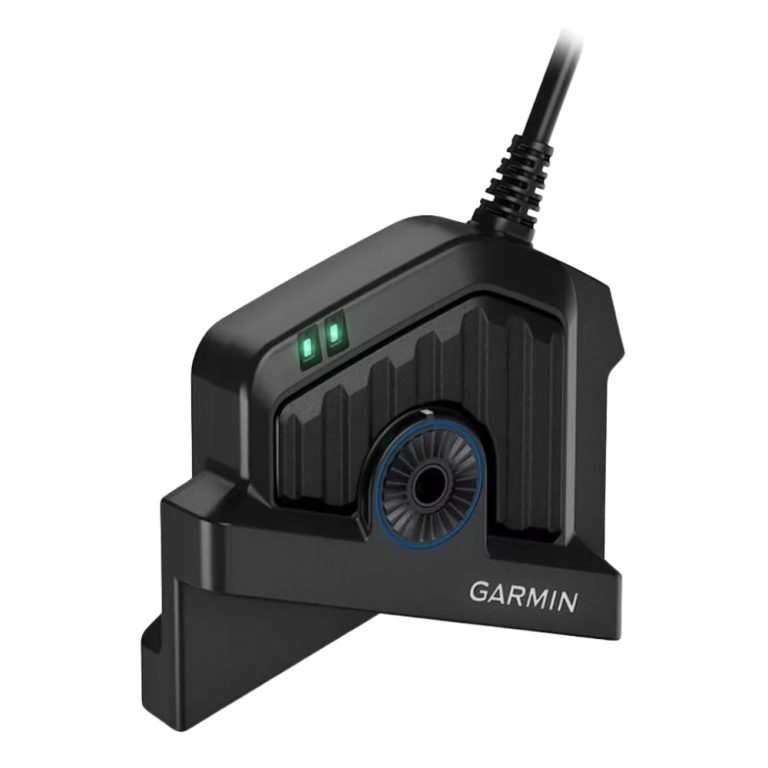
Forward facing sonar is a live sonar transducer, usually on the trolling motor or a pole, that shows fish, cover and your lure moving in front of the boat in real time. The three main systems are Garmin LiveScope, Humminbird MEGA Live 2 and Lowrance ActiveTarget 2. They do the same basic job, and each one only works with its own brand of graph. With a graph, a basic setup from us runs from about $2,370 to $3,200, so the graph you already own usually makes the choice for you.
How forward facing sonar works
A normal fish finder sends one cone of sound straight down and draws what comes back as a scrolling history. By the time a fish shows as an arch, you’re already on top of it.
Live sonar works differently. The transducer face holds an array of small sonar elements instead of one round element. The sonar fires and listens across that array and builds a thin, fan-shaped picture of the water, then redraws it continuously. Fish move across the screen as they swim.
The slice is narrow. Garmin’s current transducers use a beam about 20 degrees thick, and Lowrance lists its ActiveTarget 2 XL at 20 x 180 degrees. If a fish is outside that slice, it isn’t on the screen, even if it’s 10 ft away. That’s why so much of this gear is about pointing the transducer.
Reading the screen
In the forward view, distance from the boat runs across the screen and depth runs down it. The bottom shows as a bright line or band. Brush, rock and timber show as solid shapes that stay put. Fish show as smaller marks that move, and bait shows as clouds that shift and split.
You can also see your lure. A jig shows as a small, steady mark falling through the water, and you can watch a fish swim up to it. For a lot of anglers, that’s the whole point.
The three views
All three brands give you a forward view and a down view. The third view tilts the beam flat so it reads like a top-down map of what’s around the boat. Garmin calls it Perspective, Lowrance calls it Scout, and Humminbird has its own top-down mode on MEGA Live 2.
- Forward: for casting to cover and watching fish react to the bait.
- Down: for vertical jigging, timber and ice fishing.
- Top-down: for scanning flats and finding schools before you get close.
What it doesn’t replace
Live sonar doesn’t replace the regular transducer on your graph. You still want 2D for depth and bottom hardness, and down and side imaging to find structure over a wide area while you idle.
The usual approach is to find the spot with side imaging or a 360 scan, then fish it with live sonar. The two do different jobs, and a thin live beam is a slow way to search a whole creek arm.
The three systems side by side
Here are the numbers each maker publishes for the current models we sell. Range figures are the maker’s maximums. Real range depends on salinity, bottom type and conditions.
| Spec | Garmin LiveScope 2 (LVS44) | Humminbird MEGA Live 2 | Lowrance ActiveTarget 2 |
|---|---|---|---|
| Separate sonar module | No | No | Yes |
| Views | Forward, Down, Perspective | Forward, Down, top-down | Forward, Down, Scout |
| Max range listed | 250 ft | 150 ft | Not on Lowrance’s spec page |
| Power | 12V or 24V, 7.5 A fuse | 10 to 20 VDC on a 12V supply, 2 A fuse | 10.8 to 31.2 VDC, 3 A fuse |
| Graphs we sell that run it | ECHOMAP UHD2 sv, ECHOMAP Ultra 2, most GPSMAP | XPLORE, APEX | Elite FS, HDS PRO |
| Our price | $1,999.99 | $1,599.99 | $1,399.99 (system) |
Garmin also sells the older LiveScope Plus and the long-range LiveScope XR, which Garmin rates at up to 500 ft in fresh water. Both need a GLS 10 module. Our Garmin LiveScope guide covers all four Garmin versions.

What each system needs on your boat
Each one needs three things: a compatible graph, a power supply and a place to mount the transducer. The details differ by brand.
Garmin LiveScope
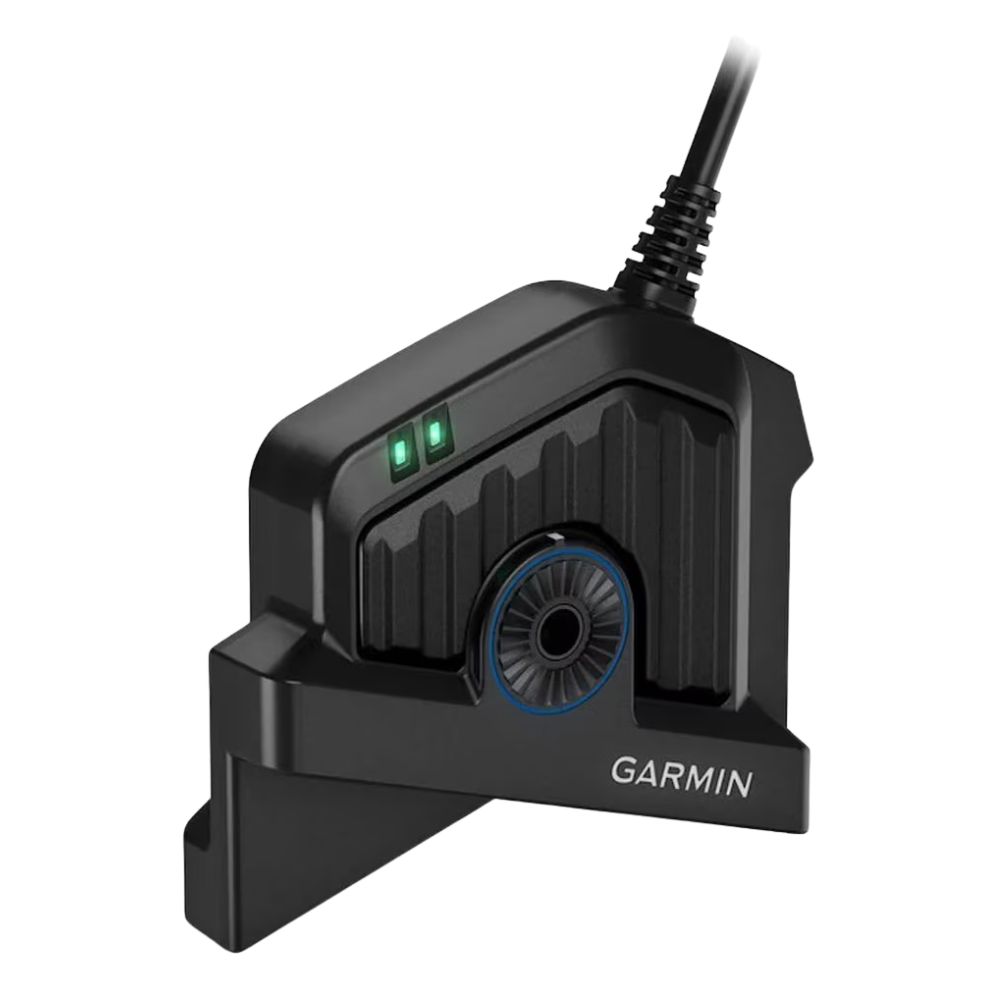
LiveScope 2 (the LVS44 and LVS42HD) connects straight to a compatible Garmin chartplotter with no black box. It needs a networked Garmin unit such as an ECHOMAP UHD2 sv, ECHOMAP Ultra 2 or GPSMAP. Garmin’s STRIKER fish finders can’t run it. The chartplotter software has to be updated during the install, per Garmin’s manual.
LiveScope Plus and XR plug into the GLS 10 module ($599.99), which runs on 10 to 32 V. Both the module and the new transducers use a 7.5 A fast-acting fuse.
Humminbird MEGA Live 2
MEGA Live 2 connects to the graph’s Ethernet port, or to an Ethernet switch if you’re running more than one graph. Humminbird’s compatibility page lists every XPLORE and APEX model, plus SOLIX G3, which we don’t sell. APEX and SOLIX G3 need software 5.060 or later. HELIX units don’t work with it.
Power is 10 to 20 VDC, and Humminbird’s install guide says it must go to a 12 VDC supply through a 2 A fuse. A GPS heading sensor is needed for the navigation features. Our MEGA Live 2 guide has the full setup.
Lowrance ActiveTarget 2
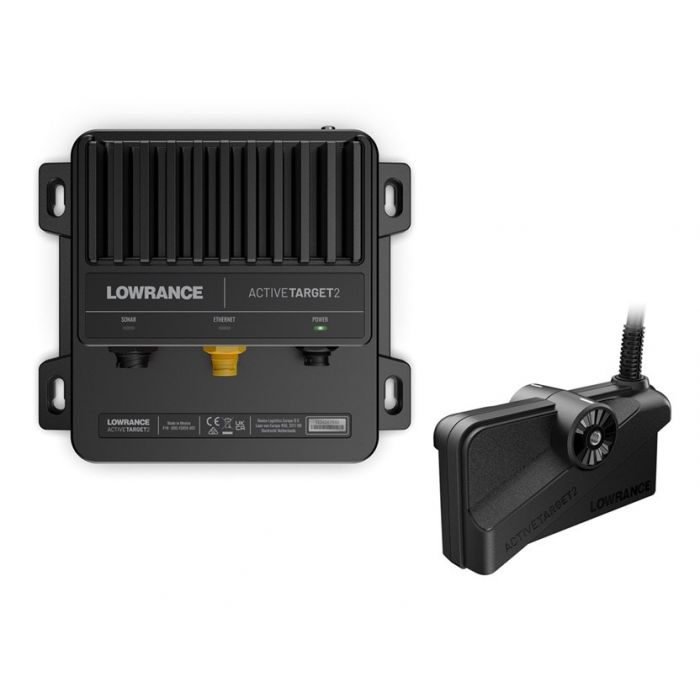
ActiveTarget 2 is a module plus a transducer. The module connects to the graph over Ethernet. Lowrance lists HDS PRO, HDS LIVE, HDS Carbon and Elite FS as compatible, and we sell the Elite FS and HDS PRO.
The module runs on 12V or 24V systems, 10.8 to 31.2 VDC, draws 1.5 A at 13.8 V and takes a 3 A fuse. The transducer cable is 25 ft. If that’s short, we carry a 10 ft extension cable ($100).
On an HDS PRO, Lowrance lets you add a second ActiveTarget 2 for combined views, including Forward plus Scout, a 180 view and Scout Wide. If you’re going that way, the module only ($844.99) and transducer only ($999.99) are sold separately. More on the graphs is in our Lowrance fish finder guide.
Cable lengths and where things go
Measure your boat before you order. The transducer sits at the bow, and the graph, module and power source are often somewhere else.
- Garmin LiveScope 2: 18 ft transducer cable. Garmin sells 3 ft and 10 ft extensions, up to 20 ft combined.
- Humminbird MEGA Live 2: a 20 ft Ethernet cable to the graph and a 10 ft power cable. Humminbird says to extend power with 12 gauge stranded copper wire.
- Lowrance ActiveTarget 2: a 25 ft transducer cable to the module. The module is 8.63 x 7.56 x 2.86 inches and weighs 4.12 lb, so it needs a dry, flat spot.
If your bow graph is close to the trolling motor, all three reach easily. If you want live sonar on a console graph too, plan the cable run and any network switch before you buy.
Forward facing sonar mounts
The mount decides how you aim the beam, and that matters as much as which brand you buy. There are three basic approaches.
Fixed to the trolling motor
This is the cheapest and simplest. Garmin’s LiveScope 2 transducers come with a barrel mount and a Perspective mount, Humminbird includes a shaft mount and a top-down bracket, and the ActiveTarget 2 kit includes trolling motor mounts for Forward, Down and Scout.
The transducer points wherever the motor points. That’s fine when you’re steering toward cover. It’s a problem when you’re holding on spot lock and the motor keeps correcting, because the picture swings with every correction.
Humminbird lists Ultrex, Ultrex QUEST, Fortrex, Maxxum and Edge as compatible motors for MEGA Live 2. For other motors, a machined mount like the Live View Transducer Mount ($333) clamps the transducer to the motor. It’s listed for Garmin Force plus several Minn Kota and MotorGuide motors.
Steered on its own
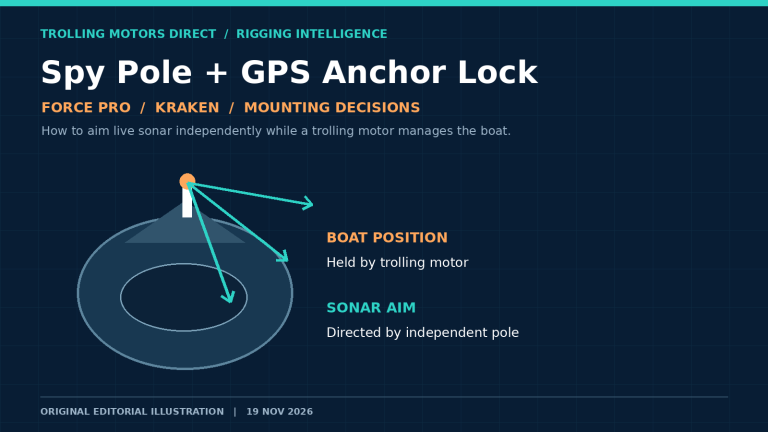
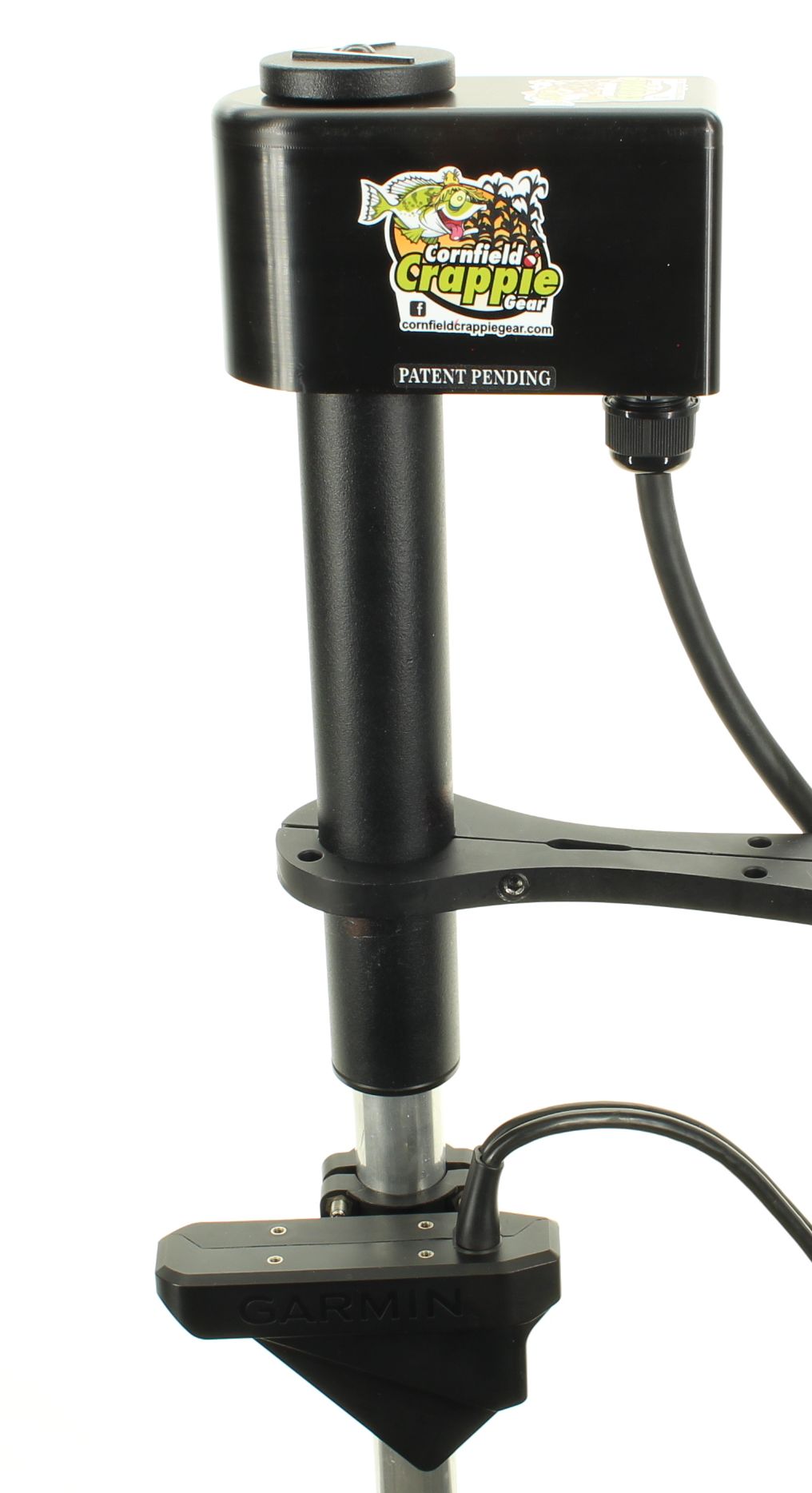
These mounts let you point the sonar one way and the boat another. Garmin’s Spy Pole ($1,999.99) is motorized, can lock onto a spot or sweep, and mounts to a Force or Force Pro or a gunnel mount. Humminbird’s TargetLock does a similar job for MEGA Live, and we don’t sell it.
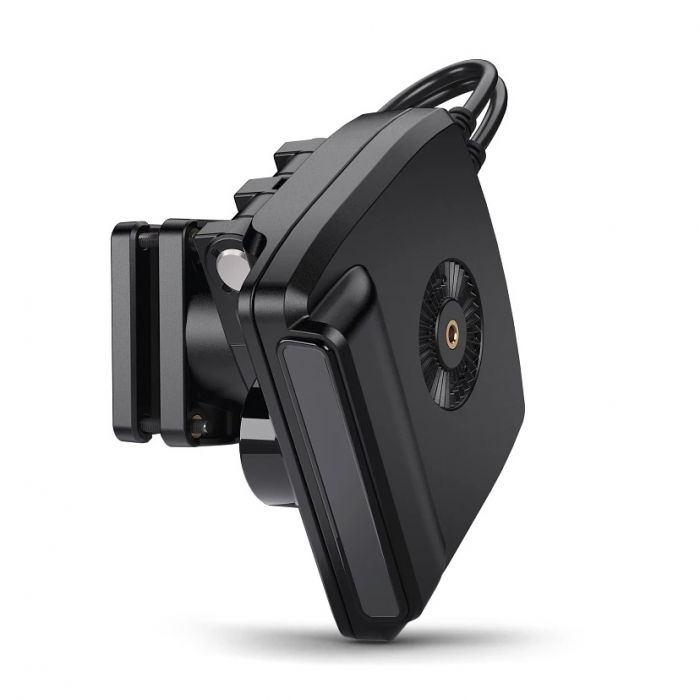
The Live Sweep ($1,099) is a 12V arm that turns the transducer up to 320 degrees, run from a pedal and a remote fob. The Cable Steer ($475) does it by hand with a knob mounted next to your graph. The Live Sweep is listed for Garmin, Humminbird and Lowrance live transducers.
On a pole or over the side
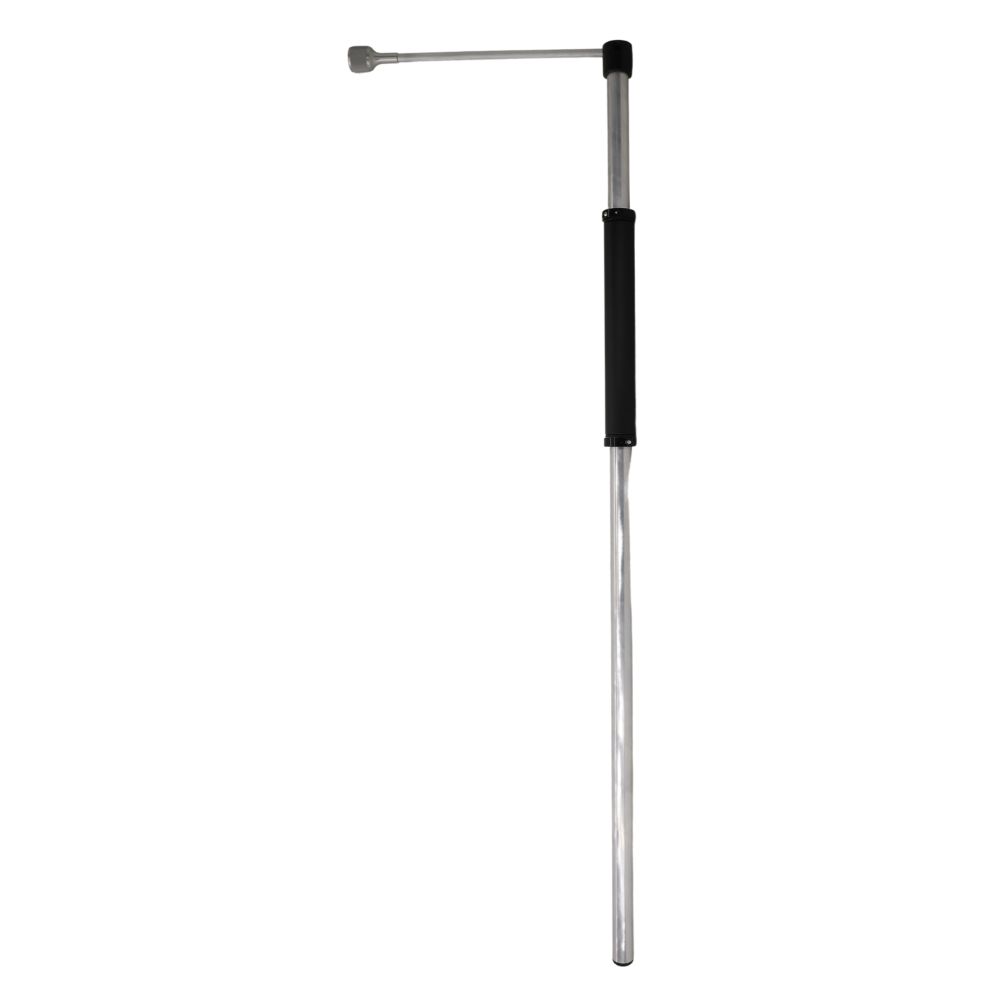
A manual pole is the cheapest way to aim independently. The Handscope ($265) comes in 52 and 62 inch lengths and is listed for Garmin, Humminbird and Lowrance live transducers. You turn it by hand.
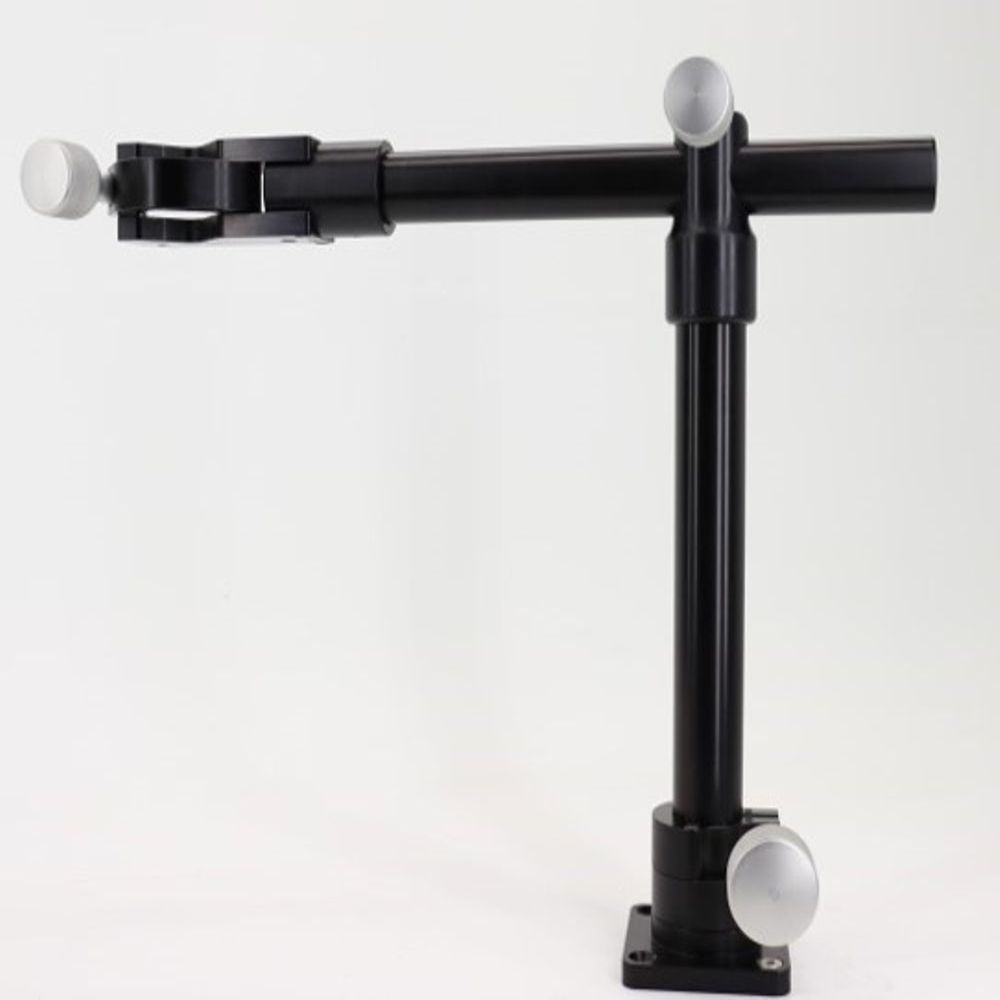
The Over the Side Mount ($389) clamps to the deck, telescopes up and down and swivels, and holds a Live Sweep, Handscope or Cable Steer off the side of the boat. It works on boats without a bow mount motor, and it keeps the sonar off the trolling motor entirely.
A rough way to choose:
- Casting docks and banks off the trolling motor: a motor mount is fine. You’re steering toward what you’re fishing anyway.
- Holding on spot lock over open water: an independent mount, so the picture stays put while the motor corrects.
- Small boat or no bow mount: a Handscope on an Over the Side Mount.
All of our forward facing sonar mounts are in the transducer mounts section.
What a full setup costs
Here’s what a working setup costs at our prices, with the lowest-priced compatible graph we sell for each brand.
| Setup | Sonar | Graph | Total |
|---|---|---|---|
| Lowrance ActiveTarget 2 | System, $1,399.99 | Elite FS 9, no transducer, $969.99 | $2,369.98 |
| Humminbird MEGA Live 2 | $1,599.99 | XPLORE 9 CHO, $1,299.99 | $2,899.98 |
| Garmin LiveScope Plus | LVS34 + GLS 10, $1,899.98 | ECHOMAP UHD2 93sv, $1,199.99 | $3,099.97 |
| Garmin LiveScope 2 | LVS44, $1,999.99 | ECHOMAP UHD2 93sv, $1,199.99 | $3,199.98 |
That’s the starting point. You’ll likely add some of these:
- A mount: from $265 for a Handscope to $1,099 for a Live Sweep, or $1,999.99 for a Spy Pole.
- A graph mount: a deck single monitor mount is $241 if the graph goes on the bow.
- Wire and fuses: enough heavy wire for a bow to stern run, and an inline fuse of the size the maker lists.
- A heading sensor for Humminbird: the AS GPS HS is $269.99.
- A second screen: a common setup is live sonar on its own graph and maps on another.
Electronics are final sale here, so confirm the graph, software and mount before you order.
The learning curve
The hardware is the easy part. Reading the screen takes time on the water, and there’s no shortcut for it.
Expect your first trips to go to learning what things look like. A brush pile, a school of shad and a single bass all look different once you’ve seen them a few times. The usual advice is to start on cover you already know, so you can match the picture to what’s down there.
Settings matter too. Garmin’s tip for its live sonar is to spend a couple of hours on the water changing settings and watching what each one does. Gain, noise and contrast controls all change how clean the picture is and how well a lure shows.
A simple first session:
- Pick a brush pile or dock you already know.
- Look at it in Forward from two or three different angles.
- Cast a jig past it and follow the lure down on the screen.
- Move over the top and look at it in Down.
- Change one setting at a time and watch what it does to the picture.
Two habits help:
- Remember the beam is thin: when a fish disappears, it may have just swum out of the slice. Turn the transducer a little before you assume it left.
- Match range to your cast: a longer range shows more water with less detail. Humminbird’s manual says the same thing about its range setting.
Setup tips and mistakes to avoid
These are the install steps that are easiest to get wrong.
- Check the graph and software first: MEGA Live 2 won’t run on a HELIX, LiveScope 2 needs a chartplotter software update, and APEX units need 5.060 or later. Check before you order.
- Don’t wire Humminbird to the trolling motor bank: MEGA Live 2 needs a 12 VDC supply. Humminbird says boats with 24V or 36V systems aren’t covered by its standard wiring, so give it a 12V source with a 2 A fuse.
- Use heavy wire: Garmin recommends 10 gauge marine wire from the bow to the back and says to plan runs at about twice the measured distance.
- Keep the fuse in: 7.5 A for Garmin, 2 A for Humminbird, 3 A for Lowrance. Garmin says pulling it voids the warranty.
- Leave slack at the steering joint: Garmin says to leave about 10 inches of cable so it doesn’t pull when the motor turns.
- Set the angle carefully: MEGA Live 2’s mount adjusts in 7.5 degree clicks, and Garmin’s mounts have notches and marks. The angle decides which view you get and how clean it looks.
- Install the mask on MEGA Live 2: Humminbird’s help center says to install it, and its guide recommends the short mask if you switch angles often.
- Plan your screen space: in a split view, MEGA Live 2 needs at least half the screen. A small graph split three ways won’t show much.
Run your graph and sonar software updates at home or at the dock before the first trip. It’s a lot easier than doing it on the water.
Which is the best forward facing sonar for you
There isn’t one best forward facing sonar for every boat. The brand of graph you own, and the trolling motor on the bow, matter more than small spec differences.
- You already own a compatible graph: buy the matching brand. Switching graphs usually costs more than the spec difference is worth.
- Starting from nothing on a budget: ActiveTarget 2 with an Elite FS 9 is the lowest total at $2,369.98.
- Most range or a Garmin Force on the bow: LiveScope 2 (LVS44). Garmin lists 250 ft for the LVS44 and 500 ft for XR, and Spy Pole links with the Force Pro.
- Humminbird graphs or MEGA 360 already on board: MEGA Live 2 with an XPLORE 9 or larger.
- Lowrance Ghost or Recon on the bow: ActiveTarget 2. Lowrance designs it to work with its own motors and graphs.
Gear in this guide
Questions about forward facing sonar
Can I run forward facing sonar on a 24V system?
Garmin LiveScope 2 and Lowrance ActiveTarget 2 both list 12V and 24V support. Humminbird MEGA Live 2 needs a 12 VDC supply, so on a 24V or 36V boat, power it from a 12V source.
Can I use LiveScope on a Lowrance or Humminbird graph?
No. LiveScope needs a Garmin chartplotter, MEGA Live 2 needs a Humminbird XPLORE, APEX or SOLIX G3, and ActiveTarget 2 needs a Lowrance HDS PRO, HDS LIVE, HDS Carbon or Elite FS.
Does forward facing sonar work in salt water?
Yes, with less range. Garmin rates LiveScope XR at 500 ft in fresh water and 350 ft in salt, and Humminbird notes that saltwater depth performance varies with the install, thermal layers and bottom.
Do I need a separate screen for live sonar?
No, but it helps. Live sonar needs a big part of the screen to be useful, and MEGA Live 2 takes at least half of it in a split view. A 9 inch graph works, and bigger is easier to read.
Is forward facing sonar hard to install?
If you’ve wired a graph before, it’s similar work. Mount the transducer, run power with the right fuse, connect it to the graph or module, and update the software. Routing the cable from the bow is usually the longest part.
What are the best forward facing sonar mounts?
For a tight budget, the mount that comes in the box. To aim the sonar separately from the boat, a Handscope or Cable Steer by hand, or a Live Sweep or Spy Pole with a motor.
If you’re not sure which system fits your boat, email sales@trollingmotorsdirect.org with your boat, trolling motor and graph, Monday to Friday, 9am to 6pm. We’ll tell you what works with what you have.