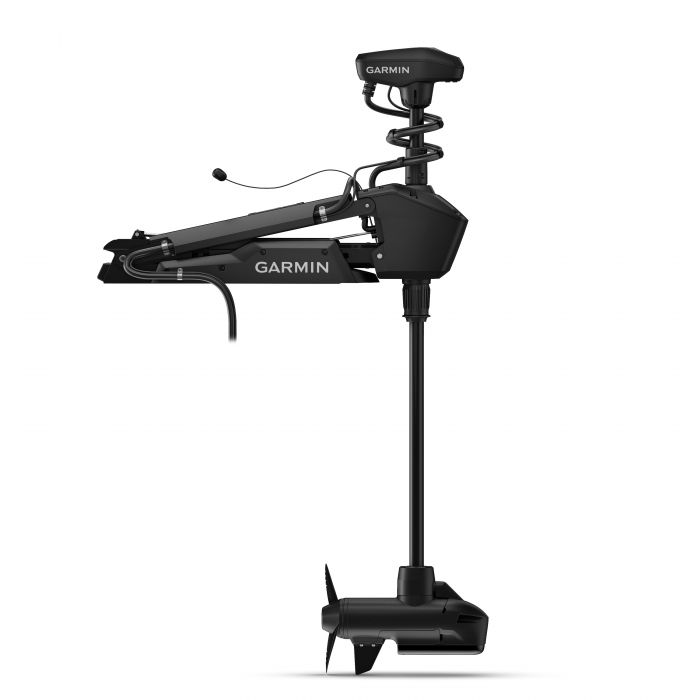
A bow mount trolling motor bolts to the front deck and pulls the boat from the bow, so the hull follows wherever the motor points. Picking one means matching thrust to the loaded weight of your boat, shaft length to the height of your bow, and the mount to the deck space you have.
We sell four of them: the Garmin Force Pro, Garmin Force Kraken, Lowrance Ghost and Lowrance Recon. Each trolling motor runs on a 24V or 36V battery bank and steers electrically, from a pedal, a remote or a compatible graph. The sizing rules below come from published manufacturer guidance, and the specs come from Garmin and Lowrance.
Why fish with a bow mount trolling motor
A transom trolling motor pushes from the back. A trolling motor on the bow pulls, and the boat tracks behind it. That makes it easier to follow a bank, hold a line in wind and turn tight around cover. It also puts you on the front deck, which is where most casting happens.
Garmin is plain about where its trolling motor goes. The Force Pro install manual says you must install the motor on the bow of your boat. Every trolling motor we stock is built that way: a bracket that bolts to the deck, a shaft that folds flat for running, and steering you control without a hand on a tiller.
GPS is the other reason people buy one now. A GPS trolling motor that holds a waypoint lets you work a brush pile without touching the pedal. Our spot lock guide covers how that works.
What size trolling motor do I need for my boat
Thrust is the first number to get right on any bow mount trolling motor. Minn Kota’s published rule is at least 2 lb of thrust for every 100 lb of boat weight when fully loaded. Their own worked example is a 2,000 lb boat, which needs at least 40 lb of thrust.
Fully loaded means everything that rides in the boat: hull, outboard, fuel, batteries, people and gear. Brochure weights are usually dry weights, so add the rest before you do the math.
Treat 2 lb per 100 lb as a floor. Minn Kota’s boat size chart steps up faster as boats get bigger, and it says to consider extra thrust if wind or current are big factors where you fish. Here is part of that chart:
| Loaded boat weight | Boat length | Thrust | Voltage |
|---|---|---|---|
| 1,600 to 2,599 lb | 16 to 17 ft | 40 to 55 lb | 12V |
| 2,600 to 3,599 lb | 17 to 18 ft | 70 to 80 lb | 24V |
| 3,600 to 4,599 lb | 18 to 19 ft | 80 to 90 lb | 24V |
| 4,600 to 5,599 lb | 20 to 23 ft | 112 to 115 lb | 36V |
Each Garmin trolling motor we sell sits at the top end of that chart. Garmin rates the Force Pro at 100 lb of thrust, and the Force Kraken at 100 lb on 36V or 80 lb on 24V, measured to the ISO 13342 standard. Lowrance doesn’t give a pound figure for the Ghost on its product page. It says the Ghost has up to 25 percent more thrust than competing models.
Voltage follows thrust. Minn Kota’s guide puts it simply: one battery for every 12 volts, so 24V takes two batteries and 36V takes three. All four of our motors run on either. A 36V bank adds a battery and its weight, but it’s the voltage the top thrust ratings are quoted at. Our 24V motor guide goes through that choice in more detail.
How to measure trolling motor shaft length for a bow mount
A shaft that’s too short lets the prop break the surface when the bow rises on a wave. The trolling motor loses its bite, gets noisy, and anchor mode struggles to hold. A shaft that’s a little long can be raised on the depth collar. A short one can’t go any deeper.
Minn Kota’s guidance is to keep the center of the motor section at least 12 inches under the water. Here is how to measure for that:
- Put the boat in the water with its normal load: batteries, fuel and the people who usually stand on the front deck.
- Mark where the mount will sit. Use the real mounting surface, not the top of a hatch lid or rub rail.
- Measure straight down from that surface to the waterline and write the number down in inches.
- If you fish rough water, add 5 inches to that number. That’s Minn Kota’s adjustment for big water.
- Find your number in the chart below to get a recommended shaft length.
- Pick the closest length the trolling motor you want is made in. If you’re between two, take the longer one.
- After install, set the depth collar so the motor runs deep enough when deployed, then check it still stows properly.
| Mounting surface to waterline | Recommended shaft length |
|---|---|
| 16 to 22 in | 42 to 45 in |
| 22 to 28 in | 48 to 52 in |
| 28 to 34 in | 54 to 60 in |
| 34 to 52 in | 72 to 87 in |
Those rows come from Minn Kota’s bow mount shaft length chart. A quicker shortcut some shops use is to measure to the waterline and add about 20 inches. On a high bow, Minn Kota’s chart comes out a few inches longer than that, so go with the chart when the two disagree.
Matching your measurement to our four motors
Each motor is made in a short list of lengths. The Ghost comes in 47, 52 and 60 inches. The Force Pro comes in 50 or 57 inches. The Recon is 48, 54, 60 or 72 inches in freshwater trim, and 54, 60 or 72 inches in saltwater trim. The Kraken runs 48, 63, 75, 90 and 110 inches. Garmin aims the 48 inch Kraken at boats with less freeboard, such as pontoons and flats boats.
So a boat that measures 24 inches from the mount to the water lands in the 48 to 52 inch row. That’s a Ghost 52, a Force Pro 50, a Recon 48 or a Kraken 48. Add 5 inches for rough water and you’re at 29 inches, which points to 54 to 60. Now you’re looking at a Force Pro 57, a Ghost 60 or a Recon 54 or 60.
Learning how to measure trolling motor shaft length before you buy avoids the classic mistake: a motor that looks fine at the dock and cavitates in a 2 ft chop.
Stow and deploy: scissor mounts and pivot mounts
Every bow mount trolling motor has to fold flat for running and stand up for fishing. How the mount does that decides how much deck it takes and how much effort it is to use.
Scissor-style mounts on the Force Pro and Ghost
The Force Pro uses a scissor-style mount with two gas springs and a reinforced pull cable that raises and lowers it. The springs take much of the effort out of lifting it, and that helps, because Garmin lists the Force Pro at 66.7 lb for the 50 inch model and 70.7 lb for the 57 inch, with the mount and cables included.
The Ghost also uses a scissor-style mount with dual-action gas springs for stowing and launching. Lowrance adds a 360 degree breakaway, so if the lower unit hits a stump the shaft can swing out of the way and realign afterwards. A built-in stabilizer bar cuts down bouncing when you run on plane in rough water.
Pivot-style mounts on the Kraken and Recon
The Kraken pivots on two hinge points. A latch pedal on the mount releases it. When you stow it, the trolling motor steers itself to 90 degrees, then you tilt the shaft back, bring it level and slide it into the catch until it locks. Garmin says it chose a pivot-style mount for boats where bow space is limited.
The Kraken is also lighter than you might expect for its length. Garmin lists 50 lb for a 48 inch white model and 58 lb for the 110 inch, motor, mount and cables included.
Lowrance lists the Recon with a pivot-style electric-steer mount and several accessory mounting points for sonar and other gear. Check its stowed length against your deck the same way you would for any other bow mount trolling motor.
Deck space and bracket fit for a bow mount trolling motor
Stand on your bow with a tape measure before you buy. Garmin’s Force Pro install manual spells out what the mounting spot needs, and it works as a checklist for any brand:
- Centerline: the deployed motor should sit as close to the boat’s centerline as you can get it.
- Overhang: the mount bumper has to hang over the gunwale or the edge of the deck.
- Access underneath: you need room under the deck to fit washers and nuts on every bolt.
- Clear travel: nothing can be in the way between the stowed and deployed positions.
- Deck strength: the deck has to take the motor’s weight and thrust. Add a backing plate or reinforce it if it can’t.
- Metal nearby: keep large metal objects, like a tool box, at least 3 ft from the display panel. Metal upsets the compass, and autopilot depends on it.
Stowed length is the other number to check. Garmin’s Kraken manual lists it at 61 7/16 inches for the 48 inch shaft, 88 1/2 inches for the 75 inch and 123 3/8 inches for the 110 inch. A long shaft needs a long deck, and a trolling motor that hangs far past the bow when stowed is more exposed on the trailer and at the dock.
The Force Pro base has two mounting hole options on the port side at the bow end. Garmin says to choose based on the installation angle and the hull shape, so try both against the paper template before you drill.
If the trolling motor ends up further forward than you’d like, a slide can move it back along the deck. We cover slides, stabilizers and sonar brackets in our guide to motor and sonar mounts.
Bow mount trolling motor install checklist
These steps use Garmin’s Force Pro numbers where a number is needed. A Lowrance trolling motor follows the same order, but check your own manual for their electrical specs.
- Confirm the shaft length against your waterline measurement.
- Lay the template on the deck with the bumper over the edge. Look underneath for wiring, foam or a livewell before you drill anything.
- Use hand tools. Garmin warns that power tools can damage parts and void the warranty.
- Plan a breaker between the battery bank and the trolling motor. Garmin specifies one rated for 60 A continuous and at least 42 VDC, and it isn’t in the box.
- If the power cable won’t reach, extend it with the right wire. Garmin’s table allows 6 AWG at minimum, and recommends 4 AWG for 10 to 20 ft extensions and 2 AWG for 20 to 30 ft.
- Add a plug and receptacle rated 60 A or more at the bulkhead if you want to disconnect the motor easily. Our plug wiring notes cover that job.
- Wire the battery bank for the voltage you chose: two 12V batteries in series for 24V, three for 36V.
- Set the depth collar, deploy the trolling motor and check how deep it sits. Stow it again and make sure it rests where it should on the mount.
- Test the pedal and remote, then connect the motor to your graph.
- Run it at the dock before the first trip: deploy, stow, steer both ways and try anchor mode.
Garmin says the Force Pro battery bank must be able to supply 60 A continuously. If you extend the power cable, size the wire from Garmin’s table, not from whatever is left over in the garage.
Foot pedal or remote
Steering is personal, and most of these motors give you both options. Here is what comes with each one:
- Garmin Force Pro: Garmin’s install manual covers a wireless foot pedal and a wireless remote, both paired to the motor at the factory. You can also steer from a compatible Garmin chartplotter or smartwatch.
- Garmin Force Kraken: comes with a wireless remote, and Garmin says it floats. The Kraken manual lists the foot pedal as sold separately, so budget for one if you like steering with your foot.
- Lowrance Ghost: built around a configurable foot pedal with programmable shortcut keys and a flip switch for left or right side use. The TMR-1 GPS remote is an add-on, and an HDS or Elite FS touchscreen can run the motor too.
- Lowrance Recon: comes with the FreeSteer joystick remote, which has a color screen and can step the boat diagonally in eight directions. Lowrance includes a wireless foot pedal with the freshwater Recon models only.
Which is better depends on how you fish. A pedal keeps both hands on the rod and works without looking down. A remote lets you walk to the back deck or sit down and still steer. If you fish alone and cast all day, start with a pedal. If you share the boat or fish from a center console, a remote you can carry is easier.
Add-ons we stock: the TMR-1 remote for the Ghost is $153, and the Lowrance Advanced Wireless Foot Pedal is $560.99. It runs on 3 AA batteries or 12V. If you want a pedal for a Kraken, email us first so we send the right Garmin part.
The four bow mount trolling motors we sell
| Motor | Shaft lengths | Voltage | Mount | Our price |
|---|---|---|---|---|
| Garmin Force Pro | 50, 57 in | 24V or 36V | Scissor-style, gas springs | $4,199.99 |
| Garmin Force Kraken | 48, 63, 75, 90, 110 in | 24V or 36V | Pivot-style | $3,999.99 |
| Lowrance Ghost | 47, 52, 60 in | 24V or 36V | Scissor-style, 360 degree breakaway | $3,199.00 |
| Lowrance Recon | 48, 54, 60, 72 in (freshwater); 54, 60, 72 in (saltwater) | 24V or 36V | Pivot-style | $3,669.99 |
The shaft lengths are each maker’s full range. Check the product page for the lengths we can supply right now, or email us.
Gear in this guide
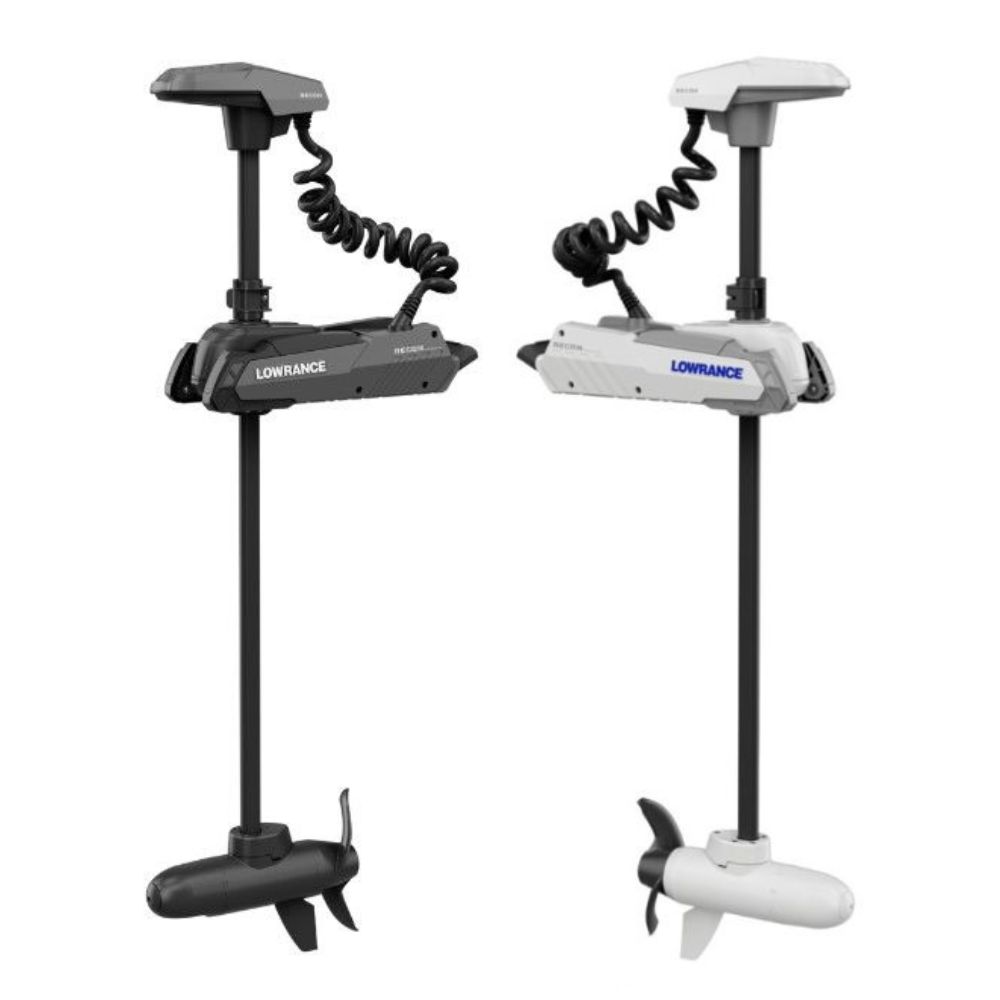

Garmin’s Force Pro ($4,199.99) uses multi-band GPS and a built-in heading sensor for anchor lock, route following and heading hold. It has a GT56UHD transducer built in, with ClearVü, SideVü and CHIRP sonar. Garmin puts a weedless prop and a high-efficiency prop in the box.
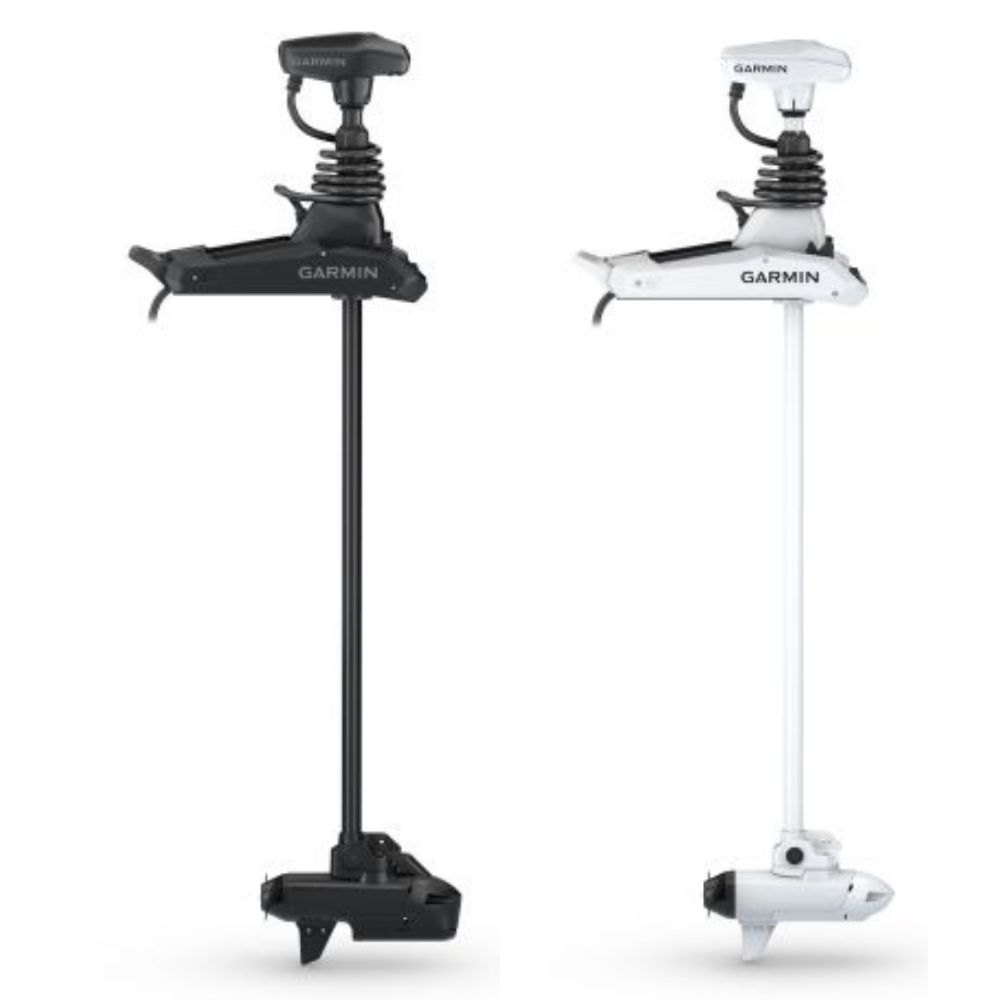
For salt water or a tall bow, look at the Garmin Force Kraken ($3,999.99). It has a composite shaft with corrosion and saltwater protection and comes in black or white. The long shafts suit center consoles and bay boats, and the pivot mount helps on short decks.
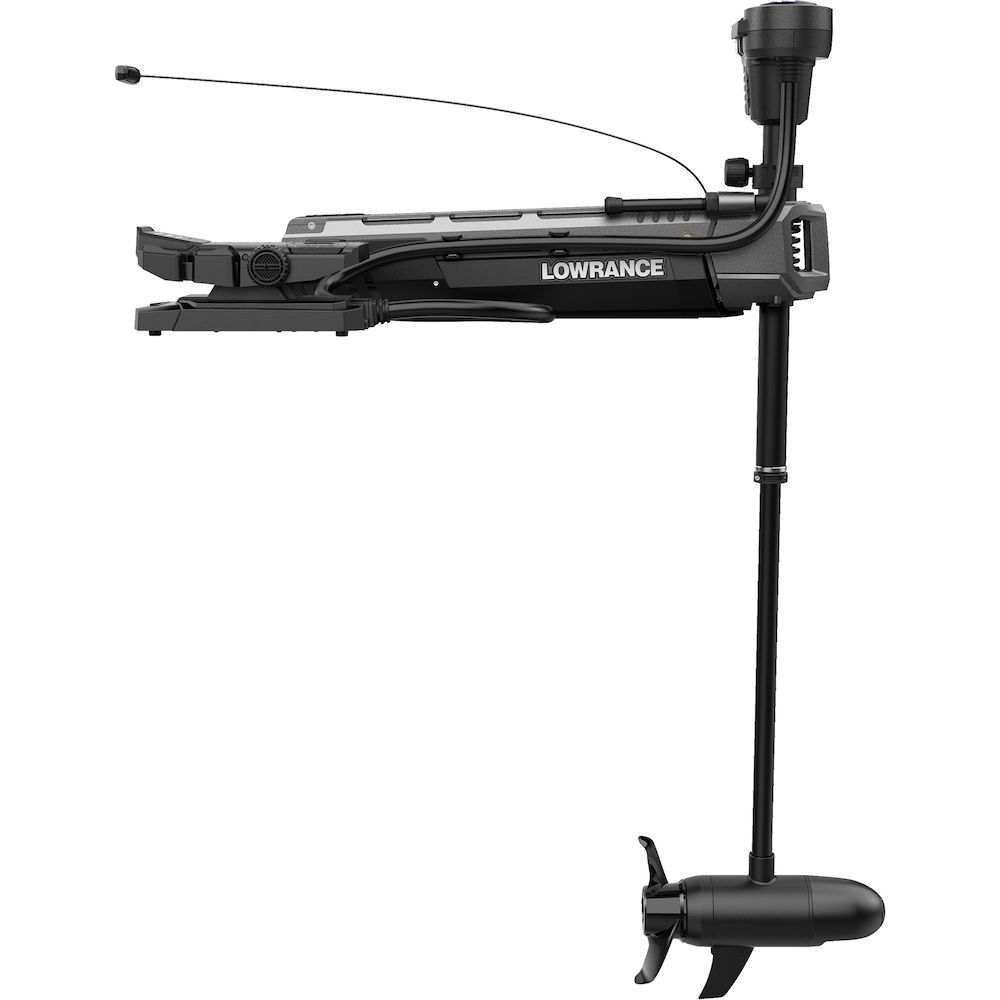
At $3,199.00, the Lowrance Ghost is the lowest priced of the four. It ships with an HDI nosecone transducer for CHIRP and DownScan, and Lowrance sells it as a freshwater motor. Our Ghost write-up has more on it.
The Lowrance Recon ($3,669.99) adds the FreeSteer remote and NMEA 2000, and it comes in freshwater and saltwater versions. Lowrance gives it a lifetime shaft warranty and a three-year motor warranty.
Which bow mount we’d pick
Start with the graph on your dash, then let shaft length and deck space narrow down the bow mount trolling motor that fits.
- Garmin graphs on a bass boat: the Force Pro. It talks to Garmin chartplotters and comes with both props.
- Garmin graphs on a bay boat, center console or pontoon: the Kraken, for the saltwater build, the long or short shaft options and the pivot mount.
- Lowrance graphs and fresh water only: the Ghost, which is also the cheapest GPS bow mount we sell at $3,199.00.
- Lowrance graphs and salt water, or a tall bow: the Recon, with saltwater versions and a 72 inch shaft.
- Humminbird graphs: choose on shaft length and mount style. We have MEGA 360 mounts made for the Kraken and Recon in our MEGA 360 mount section.
You can see all four side by side on our trolling motors for sale page, and spare props, pedals and remotes are in trolling motor accessories. Motors and electronics are final sale, so check fit before you order.
Questions about bow mount trolling motors
Can I put a bow mount trolling motor on a pontoon?
Yes. Garmin built the 48 inch Kraken with pontoons, flats boats and microskiffs in mind. You still need a solid, flat spot at the front with room to bolt through and fit nuts underneath.
What size trolling motor do I need for an 18 ft boat?
Minn Kota’s chart puts a 17 to 18 ft boat that weighs 2,600 to 3,599 lb loaded at 70 to 80 lb of thrust on 24V. At 18 to 19 ft and 3,600 to 4,599 lb it moves up to 80 to 90 lb. Garmin rates the Force Pro at 100 lb and the Kraken at 100 lb on 36V, which clears that with room for wind, so shaft length and the graph on your dash will decide it.
How deep should a trolling motor sit in the water?
Minn Kota recommends at least 12 inches of water over the center of the motor section. Set the depth collar for that at the dock, then check it again on a windy day.
Is a longer shaft better?
Up to a point. A long shaft can be raised on the depth collar, while a short one can’t go deeper. Too long, and the motor hangs further past the bow when stowed and sits deeper than you need in skinny water.
Do I need 36V for a bow mount trolling motor?
Not always. All four of our motors run on 24V or 36V. Garmin rates the Kraken at 80 lb on 24V and 100 lb on 36V, so 36V gets you the full rating. Check Minn Kota’s chart against your loaded weight first, and see our battery guide before buying batteries.
Can I use a bow mount trolling motor in salt water?
Some of them. The Kraken has a composite shaft with corrosion and saltwater protection, and the Recon comes in saltwater versions. Lowrance sells the Ghost as a freshwater trolling motor. Garmin’s manuals say to rinse the motor with fresh water after any salt or brackish trip.
Ask us before you order
Email sales@trollingmotorsdirect.org with your boat make, model, length and the mount-to-waterline measurement, and we’ll check the shaft length with you. We’re in Monday to Friday, 9am to 6pm.