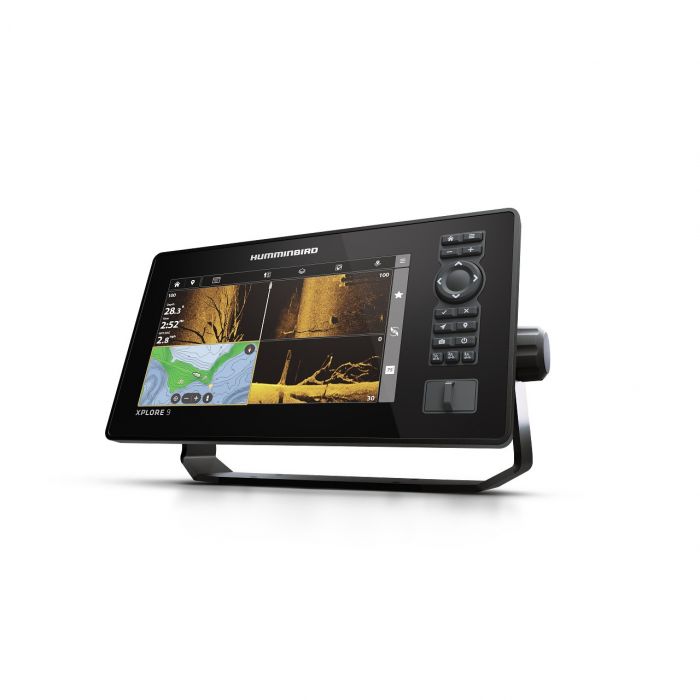
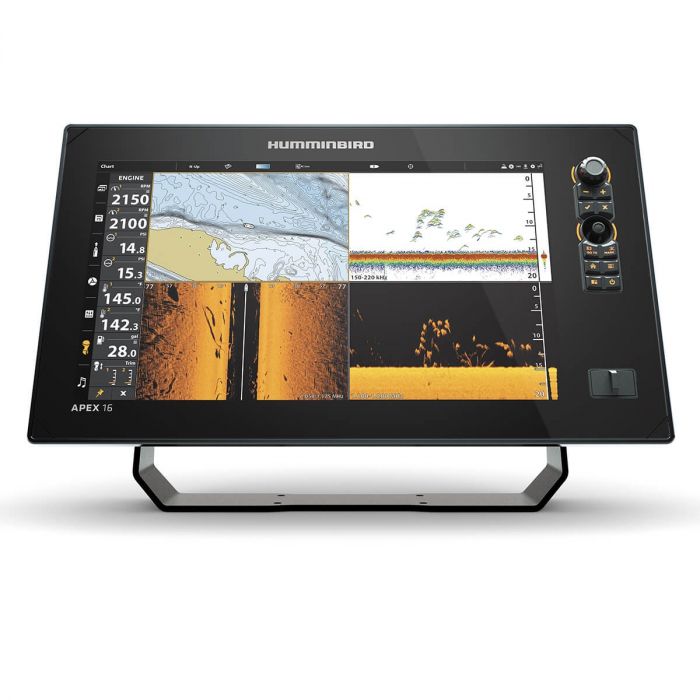
A Humminbird fish finder from our shop is either an XPLORE or an APEX. The XPLORE comes in 9, 10 and 12 inch sizes and is what most bass and walleye boats need: MEGA Side and Down Imaging, support for MEGA Live 2 and MEGA 360, and lake maps in the box. The APEX comes in 13, 16 and 19 inch sizes and adds 1920 x 1080 screens, two Ethernet ports and HDMI for a bigger helm.
We don’t sell the HELIX, Humminbird’s lower-priced line. It’s covered below so you can see where that Humminbird fish finder fits, but it won’t run MEGA Live 2.
Brand change: on October 6, 2026, Johnson Outdoors moved Humminbird’s fish finders under the Minn Kota name. Humminbird lives on as Humminbird Imaging, the sonar inside the new Minn Kota X Series. Minn Kota says XPLORE, APEX and SOLIX G3 owners get the new system features, such as Draw & Navigate and a wireless link to the trolling motor, through a software update. That includes the XPLORE and APEX units we sell.
The Humminbird family: HELIX, XPLORE and APEX
The Humminbird fish finder lineup has three lines that matter for a fishing boat, plus the SOLIX, which we also don’t stock.
- HELIX: the long-running mainstream line, in sizes from 7 to 15 inches in the current G4 and G4N versions. On Humminbird’s own store a HELIX 7 SI GPS G4 is $649.99 and a HELIX 7 MSI GPS G4N is $999.99.
- XPLORE: announced in December 2024 and on sale from January 2025. By price it sits between HELIX and APEX.
- APEX: the big-screen line in 13, 16 and 19 inch sizes.
- SOLIX: MEGA Live 2 works with the SOLIX G3 but not older SOLIX units.
The HELIX is still a sensible fish finder for 2D, imaging and even MEGA 360 on G3N and G4N models with MEGA Imaging+. The limit is live sonar. When Humminbird launched MEGA Live 2, it said the new unit works with APEX, XPLORE and SOLIX G3, and not with HELIX. If live sonar is in your plans, start with an XPLORE.
If you already run a HELIX 7 and want a better mount, we sell a Helix 7 adapter bracket ($49) that fits our gimbal plates.
Every Humminbird fish finder we sell
Screen sizes are Humminbird’s diagonal measurements for each fish finder. The XPLORE and APEX names round them off.
| Model | Screen | Transducer in the box | Our price |
|---|---|---|---|
| XPLORE 9 CHO | 9 in | None | $1,299.99 |
| XPLORE 9 CMSI+ | 9 in | XM 14 HW CMSI T | $1,499.99 |
| XPLORE 10 CHO | 10.1 in | None | $2,099.99 |
| XPLORE 10 CMSI+ | 10.1 in | XM 14 HW CMSI T | $2,299.99 |
| XPLORE 12 CHO | 12.1 in | None | $2,699.99 |
| XPLORE 12 CMSI+ | 12.1 in | XM 14 HW CMSI T | $2,899.99 |
| APEX 13 CHO | 13.3 in | None | $3,999.99 |
| APEX 13 MSI+ | 13.3 in | XM 14 HW MSI T | $4,299.99 |
| APEX 16 MSI+ | 15.6 in | MEGA SI+ transom transducer | $4,799.99 |
| APEX 19 MSI+ | 18.5 in | MEGA SI+ transom transducer | $5,299.99 |
Look at the price steps before you pick a size. Going from the XPLORE 9 CMSI+ to the 10 adds $800, and from the 10 to the 12 adds $600. The biggest jump is from the XPLORE 12 CMSI+ to the APEX 13 MSI+: $1,400 for about an inch more screen, full HD resolution, HDMI and two Ethernet ports.
For most boats the XPLORE 12 is where we’d stop. It’s the largest screen before that jump, and it runs every MEGA add-on the APEX does.
CHO vs MSI+: do you need the transducer?
CHO means control head only. You get the fish finder display, but no transducer. The MSI+ and CMSI+ versions include a transom transducer for Dual Spectrum CHIRP, MEGA Side Imaging+ and MEGA Down Imaging+.
The transducer is cheaper in the box. An XPLORE 9 CHO plus our XM 14 HW MSI T transom transducer ($449.99) comes to $1,749.98, against $1,499.99 for the XPLORE 9 CMSI+. On an APEX 13 the combo saves $149.99.
Humminbird also lists optional transducers for the XPLORE, including a 50/83/200 kHz unit and Airmar High, High Wide, Medium, Medium Wide and Low models. That’s another reason to buy a CHO if you fish deep water offshore.
A CHO Humminbird fish finder makes sense in these cases:
- You already have a compatible MEGA Imaging transducer on the boat.
- It’s a second screen that will share sonar from another Humminbird unit over Ethernet.
- It’s a bow screen that will run only MEGA Live 2 or MEGA 360.
- You want a 50 kHz or Airmar transducer for deep water instead of the standard one.
XPLORE vs APEX: which Humminbird fish finder fits your boat
XPLORE
The XPLORE is the Humminbird fish finder most boats need. It uses what Humminbird calls Cross Touch: a touchscreen plus a full keypad, so you can use either. It runs on a quad-core processor, with shortcut buttons for navigation, Spot-Lock and mapping, plus customizable One-Boat Network side buttons for presets.
- Screen: 9 inch at 1280 x 720, 10.1 inch, or 12.1 inch at 1280 x 800. Humminbird says it’s built to be read through polarized sunglasses.
- Sonar: Dual Spectrum CHIRP, MEGA Side Imaging+ and MEGA Down Imaging+. Target separation is listed at 2.5 inches.
- Maps: Humminbird Basemap plus a LakeMaster and CoastMaster VX card, with SmartStrike and AutoChart Live.
- Connections: NMEA 2000, Ethernet, Bluetooth for Talon and Raptor anchors, and Wi-Fi for software updates. It has two microSD slots.
- Power: 10.8 to 20 volts DC, with a 2.2 A draw listed for the XPLORE 9.
- Storage: 10,000 waypoints and 50 routes.
APEX
The APEX is the bigger, more connected Humminbird fish finder. All three sizes are 1920 x 1080, and they use touch and keypad controls like the XPLORE. Humminbird describes the APEX 13 screen as glass-bonded and sun-viewable.
- Screen: 13.3, 15.6 or 18.5 inches.
- Ports: two Ethernet ports, NMEA 2000, and separate HDMI in and out.
- Sonar extras: a dedicated port for 2D CHIRP transducers up to 2 kW, and an optional Deepwater CHIRP mode from 28 to 250 kHz with a compatible transducer.
- Power: 3.1 A for the APEX 13 and 4.4 A for the APEX 19.
For an inland bass or walleye boat, the XPLORE does the job. The APEX earns its price on bigger boats, offshore with a high-power 2D transducer, or anywhere you want a large screen with HDMI and several networked devices. Humminbird’s spec pages for the XPLORE and APEX list the full details.
Size, weight and mounting
Check the dash space before you order a bigger fish finder. Retail spec sheets list the XPLORE 9 at 11.69 x 6.26 x 3.3 inches, the XPLORE 10 at 12.1 x 7.25 x 3.3 inches, and the XPLORE 12 at 14.15 x 8.46 x 3.4 inches.
Weight climbs fast. Humminbird lists the XPLORE 9 at about 4 lb 4 oz and the APEX 13 at about 8 lb 5 oz. That matters on a bow mount, where every bump in the chop works the mount and the deck.
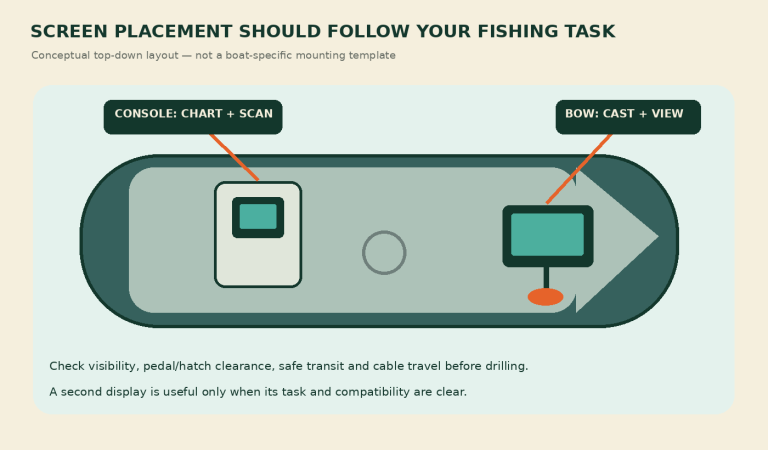
The XPLORE ships with a gimbal mount, and an in-dash kit is optional. For the bow, our telescoping swivel single mount ($413) raises the fish finder to eye level and turns at the base to cut glare. The deck single mount ($241) is the simpler option.
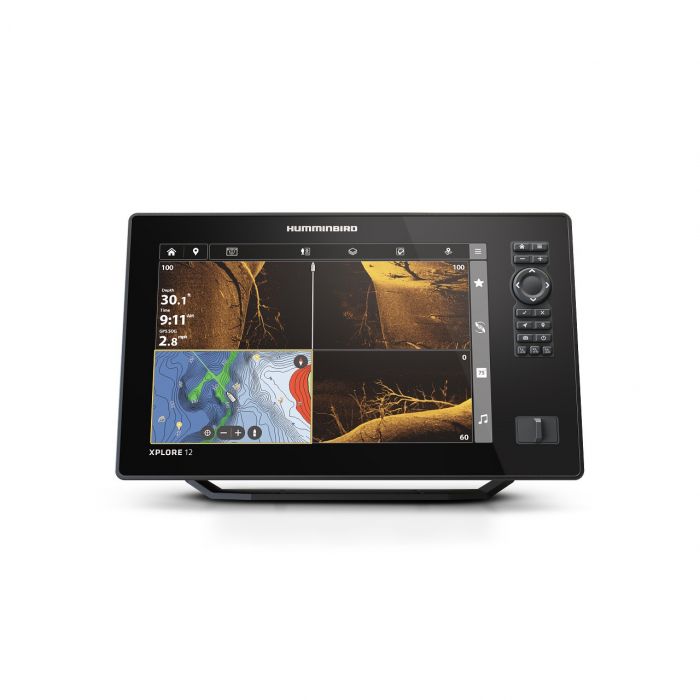
Side imaging fish finder views: MEGA SI+ and DI+
MEGA is Humminbird’s name for imaging above 1 MHz. On the XPLORE, MEGA Side Imaging+ runs from 1050 to 1175 kHz. The APEX runs MEGA Down Imaging+ at 1100 to 1200 kHz. Higher frequency means more detail and less range.
That trade-off shows in the numbers. On the XPLORE, Humminbird lists MEGA Down Imaging+ to 200 ft and 455 kHz down imaging to 400 ft. MEGA Side Imaging+ reaches out to 200 ft on either side. The APEX lists MEGA Down Imaging to 250 ft.
A side imaging fish finder from Humminbird gives you both frequencies, so you can switch. Use MEGA for detail on brush, rock and docks. Switch to 455 kHz when you need more range in deeper water.
The 2D fish finder view uses Dual Spectrum CHIRP. Full mode runs 150 to 220 kHz, narrow mode 180 to 240 kHz, and wide mode 140 to 200 kHz. With the standard transducer, Humminbird lists 2D depth to 1,200 ft, or 3,500 ft with an optional 50 kHz transducer.
Humminbird forward facing sonar: MEGA Live 2
Humminbird forward facing sonar is MEGA Live 2. It shows a live picture in front of or below the boat, with three view modes including Forward and Down. Humminbird lists the coverage as 20 by 120 degrees.
- Works with: every XPLORE and APEX, plus the SOLIX G3. Not the HELIX or older SOLIX units.
- In the box: the transducer with an adjustable bracket, a 10 ft power cable, a 20 ft Ethernet cable and mounting hardware. There’s no separate sonar module to find a home for, unlike Garmin LiveScope Plus or Lowrance ActiveTarget 2.
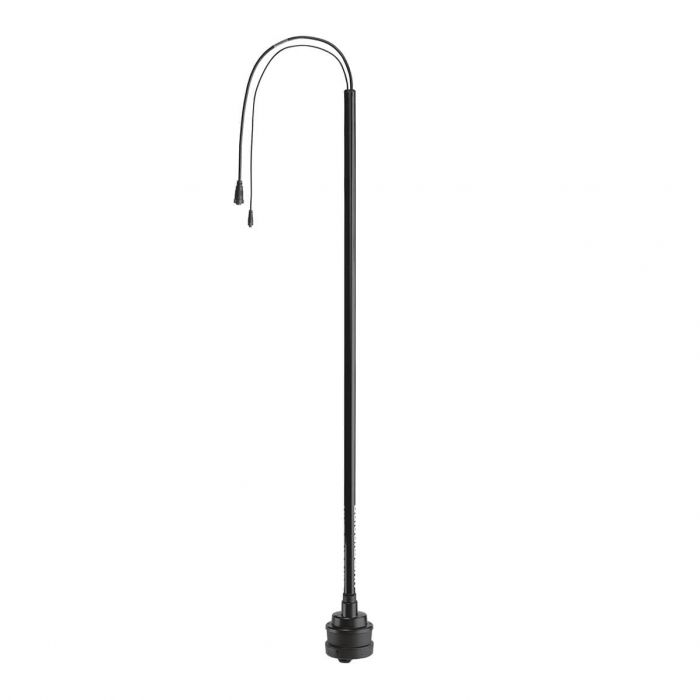
- Mounting: made for Minn Kota Ultrex, Fortrex, Maxxum and Edge shafts, and it fits most forward-facing sonar poles. A separate MEGA Live 2 transom mount is needed for the transom.
- Display tools: TargetBoost brightens suspended fish and bait, and there are 15 color palettes.
We sell MEGA Live 2 for $1,599.99. It connects over Ethernet, so plan a free port or a switch. Measure the run from the bow mount to the screen before you order, since the included Ethernet cable is 20 ft. If your trolling motor isn’t a Minn Kota, look at our transducer mounts and email us with your motor. Our MEGA Live guide goes into setup.
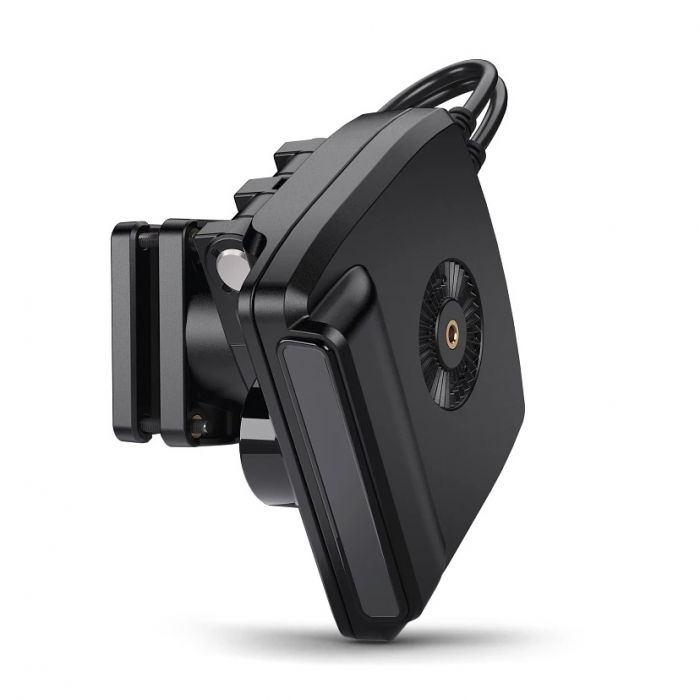
MEGA 360 Imaging
MEGA 360 mounts on the trolling motor and sweeps all the way around the boat. It has a 360 Imaging mode and a Side Imaging mode. It works with the XPLORE and APEX, the SOLIX, and HELIX G3N and G4N models with MEGA Imaging+.
It connects differently from MEGA Live. Humminbird’s support site says MEGA Live uses the Ethernet port or a switch, while MEGA 360 uses the transducer port, sometimes with a Y cable. Both can run on one unit.
We stock MEGA 360 three ways:
- MEGA 360 with no mount, $1,199.99, for use with a separate mount.
- MEGA 360 Ultrex 2 system or Fortrex system, $1,299.99 each.
- Bundles with a machined mount for the Terrova, Garmin Kraken or Lowrance Recon, $1,788.99 each.
Those mounts let you put MEGA 360 on a Garmin or Lowrance motor. The sonar still needs a Humminbird fish finder to show on.
MEGA 360 or Humminbird forward facing sonar first?
They answer different questions. MEGA 360 shows what is around the boat while the trolling motor holds you on a spot, which suits docks, brush piles and rock. MEGA Live 2 shows fish in front of you in real time, so you can watch them react to a cast.
If you fish one spot at a time and want to see the cover, start with MEGA 360. If you cast to fish you can already find on side imaging, start with MEGA Live 2. If you think you’ll want both, plan the Ethernet and transducer port now.
Connecting and setting up a Humminbird fish finder
One-Boat Network
The One-Boat Network ties a Humminbird fish finder to Minn Kota motors, Talon and Raptor shallow water anchors and Cannon downriggers. With i-Pilot Link, you can steer and set Spot-Lock from the screen. Software updates come through the One-Boat Network app.
That control is built around Minn Kota, and we don’t sell Minn Kota motors. If your trolling motor is a Garmin Force, Ghost or Recon from our shop, match your fish finder to that brand for motor control.
Ethernet
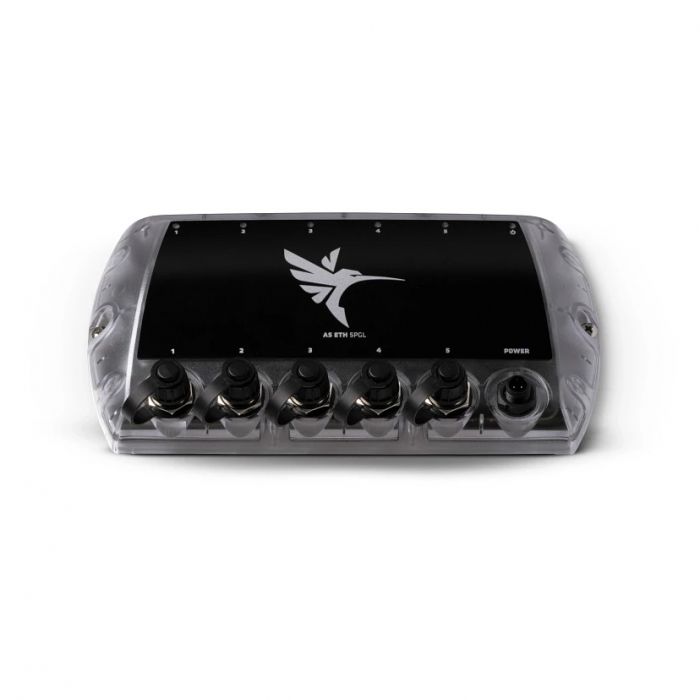
The APEX has two Ethernet ports. The XPLORE has Ethernet networking and works with Humminbird’s 5-port switch. The AS ETH 5PGL switch ($329.99) links up to five compatible Humminbird units and accessories. It helps once MEGA Live 2, a second screen and other Ethernet gear share the network.
Networking also lets two screens share sonar. Humminbird says MEGA 360 views can be shared to other compatible units over Ethernet, so a console screen can show what the bow is seeing.
Humminbird’s XPLORE spec sheet doesn’t give a port count, so if you plan MEGA Live 2 and a second screen on an XPLORE, ask us how to wire it before you order. On an APEX, the two ports cover that setup.
Charts and GPS
Every Humminbird fish finder we sell has the Humminbird Basemap, which covers more than 10,000 lakes and the continental U.S. coast. The XPLORE also includes a LakeMaster and CoastMaster VX card. Humminbird says it covers more than 13,000 lakes, waterways and coastal waters in the U.S. and Canada with 1 ft contours.
Both lines work with Navionics charts, and AutoChart Live records 8 hours of your own sonar mapping built in. On the APEX you can add more with AutoChart Zero Line SD cards. If you mount the screen in the dash, Humminbird says you need an external GPS antenna. The AS GPS HS ($269.99) is a GPS receiver with a heading sensor, and it’s listed for the APEX with Humminbird’s AS GPS adapter.
Setup checklist
- Update the software. The XPLORE can take updates over Wi-Fi once update 6.090 is installed, and the One-Boat Network app pushes updates too.
- Mount the transom transducer by Humminbird’s instructions, where water flows clean across it at speed.
- Plan the Ethernet runs. MEGA Live 2 comes with a 20 ft Ethernet cable. On an XPLORE with other Ethernet gear, budget for the switch.
- Plan the transducer port. MEGA 360 plugs in there, so a Y cable may be needed if you also run the transom transducer.
- Pair Bluetooth gear. The XPLORE and APEX pair with Talon and Raptor anchors and Cannon Optimum downriggers.
- Turn on AutoChart Live on your home lake. Eight hours of recording is built in, and it fills gaps in the chart.
Which Humminbird fish finder we’d pick
- Console on an inland boat: the XPLORE 9 CMSI+ at $1,499.99.
- Bow with live sonar: the XPLORE 12 CMSI+ at $2,899.99, plus MEGA Live 2. At 12.1 inches there’s room for live sonar and a chart side by side.
- Second screen sharing sonar: the XPLORE 9 CHO at $1,299.99, networked to the bow unit.
- Big helm or offshore: the APEX 16 MSI+ at $4,799.99.
Pick the fish finder screen first, then the transducer, then the add-ons. All of them are in our graphs category, and our general fish finder buying guide compares Humminbird with Garmin and Lowrance.
Gear in this guide

Questions about Humminbird fish finders
Does MEGA Live 2 work with a HELIX?
No. Humminbird says MEGA Live 2 works with the APEX, XPLORE and SOLIX G3, and not with HELIX or older SOLIX models. In our shop, the lowest-priced Humminbird fish finder that runs it is the XPLORE 9 CHO at $1,299.99.
What does CHO mean on a Humminbird fish finder?
Control head only. It’s the display without a transducer. The MSI+ and CMSI+ versions include a MEGA Imaging transom transducer.
Can I run MEGA 360 and MEGA Live on one Humminbird fish finder?
Yes. Humminbird says MEGA Live connects through Ethernet and MEGA 360 through the transducer port, and you may need a Y cable depending on how you connect your sonar.
Which Humminbird forward facing sonar works with the XPLORE?
MEGA Live 2, and Humminbird also lists the original MEGA Live as compatible. Both connect through Ethernet.
Does a Humminbird fish finder come with maps?
Yes. Every XPLORE and APEX has the Humminbird Basemap, and the XPLORE also comes with a LakeMaster and CoastMaster VX card with 1 ft contours. Navionics cards work too.
Is the APEX worth it over the XPLORE?
For most inland boats, no. The XPLORE 12 CMSI+ is $2,899.99 and runs the same MEGA imaging and add-ons. The APEX makes sense if you want a 13 inch or larger screen, HDMI, two Ethernet ports or a 2 kW 2D transducer.
Check fit before you order
Electronics are final sale. Email sales@trollingmotorsdirect.org with your boat, trolling motor, current fish finder and any Humminbird gear you already own, and we’ll confirm what connects. We answer Monday to Friday, 9am to 6pm.