A fish finder is a sonar screen that shows what is under and around your boat: depth, bottom, structure, bait and fish. For most bass and walleye boats, the best fish finder is a 9 or 10 inch unit with CHIRP, down imaging and side imaging, built-in GPS maps, and a transducer mounted where it reads clean water. Live sonar is the big add-on, and it can come later.
We sell Garmin, Humminbird and Lowrance units, and the prices below are our current store prices. Electronics are final sale here, which is one more reason to get the basics right before you order.
What a fish finder actually measures
The transducer sends a pulse of sound into the water and listens for echoes. The time an echo takes to come back gives the depth. The strength of the echo says something about what it hit. The screen scrolls from right to left, so the newest readings are always on the right edge.
Frequency changes the picture. Garmin’s owner’s manual puts it plainly: lower frequencies use wider beams, reach deeper water and draw bigger arches on fish. Higher frequencies use narrower beams and give better bottom and thermocline definition. You can read Garmin’s explanation on its sonar frequencies page.
CHIRP sweeps each pulse through a range of frequencies instead of using one. Garmin says this improves target separation, so two fish close together show as two marks instead of one blob. Every combo fish finder we sell has CHIRP, so it’s no longer something to pay extra for.
Sonar types, side by side
All three brands do the same basic jobs. The names are different, which makes comparing them harder than it should be. This table lines them up.
| Sonar type | What it shows | Garmin / Humminbird / Lowrance name |
|---|---|---|
| 2D CHIRP | Fish arches, bait, bottom and depth as a scrolling history | Traditional CHIRP / Dual Spectrum CHIRP / CHIRP |
| Down imaging | A picture-like view of structure under the boat | ClearVü / MEGA Down Imaging+ / DownScan |
| Side imaging | A picture of the bottom off both sides of the boat | SideVü / MEGA Side Imaging+ / SideScan |
| Live (forward-facing) | Moving, real-time view ahead of or below the boat | LiveScope / MEGA Live 2 / ActiveTarget 2 |
| 360 | A sweeping view all the way around the boat | Humminbird MEGA 360 |
2D CHIRP sonar
This is the classic fish finder view. Fish show as arches, bait as clouds or lines, and the bottom as a thick band. It also reaches deepest. Humminbird lists the XPLORE at 1,200 ft of 2D depth with the standard transducer, against 200 ft for its MEGA Down Imaging.
Humminbird’s Dual Spectrum CHIRP runs 150 to 220 kHz in its full mode, with a narrow mode (180 to 240 kHz) and a wide mode (140 to 200 kHz). Garmin’s GPSMAP xsv units run 1 kW traditional CHIRP. For most inland fishing, any fish finder from these three brands has plenty of 2D performance.
Down imaging
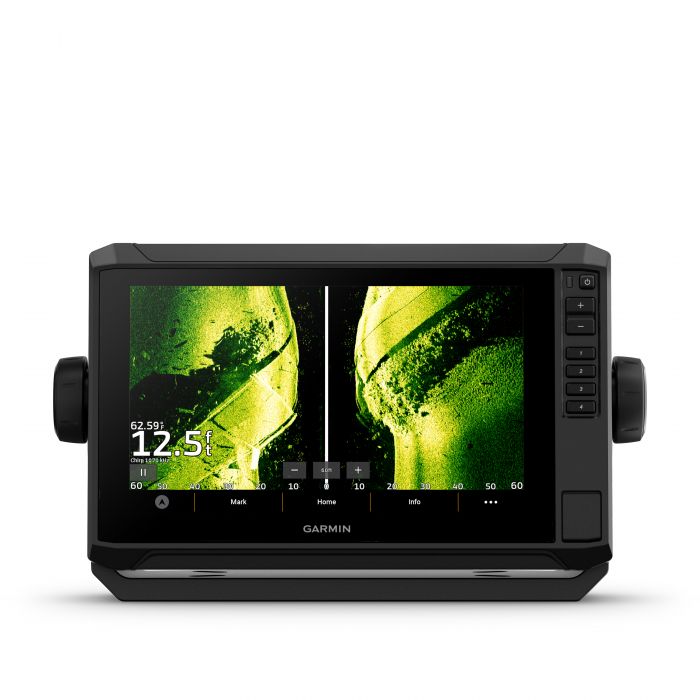
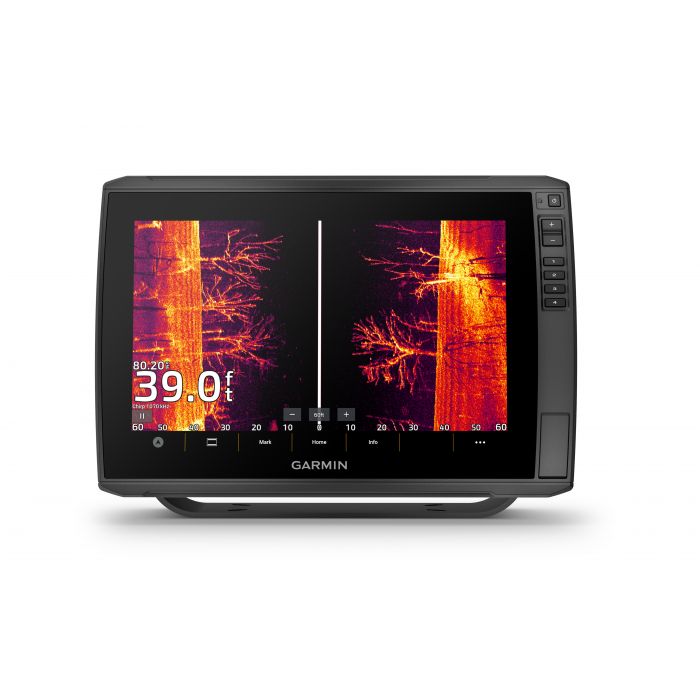
Down imaging uses high frequencies to draw a detailed picture of what the boat passes over. Brush, rock piles and standing timber look like what they are. Garmin’s manual describes ClearVü as a detailed picture of the fishing environment around the boat.
Most people run down imaging on a split screen beside 2D. The 2D view tells you a fish is there. The down view tells you what it’s sitting on.
Side imaging fish finder views
A side imaging fish finder looks left and right instead of only down. You idle along a flat, mark the brush pile or rock you would never find with a down view, then turn around and fish it. It’s a quick way to learn a new lake.
Range depends on the transducer and frequency. Garmin rates the GT56UHD-TM at up to 500 ft per side at 455 kHz. Humminbird says MEGA Side Imaging+ on the XPLORE reaches out to 200 ft on either side. Higher frequencies give more detail and less range.
Live sonar
Live sonar, also called forward-facing sonar, draws a moving picture of what is in front of or below the boat. You can watch a fish swim up to the bait. The three systems are Garmin LiveScope, Humminbird MEGA Live 2 and Lowrance ActiveTarget 2.
Our prices start at $1,299.99 for the Garmin LVS34 transducer, which also needs a GLS 10 sonar module ($599.99). The Lowrance ActiveTarget 2 system is $1,399.99 with module, transducer and mounts. Humminbird MEGA Live 2 is $1,599.99. Each one only runs on its own brand’s screens, and not every screen in a brand supports it. Our forward-facing sonar guide covers the differences.
360 sonar
Humminbird MEGA 360 turns a transducer on a shaft and paints a picture all the way around the boat. It’s useful for checking docks and brush around you while the trolling motor holds position. We sell it without a mount for $1,199.99, or set up for Minn Kota Ultrex 2 or Fortrex motors at $1,299.99. It needs a compatible Humminbird fish finder.

Choosing a fish finder for boat size and screen size
Buy the biggest fish finder screen your dash and budget allow. A split screen cuts the picture into halves or thirds, and a 7 inch screen split three ways is hard to read. Live sonar needs room too.
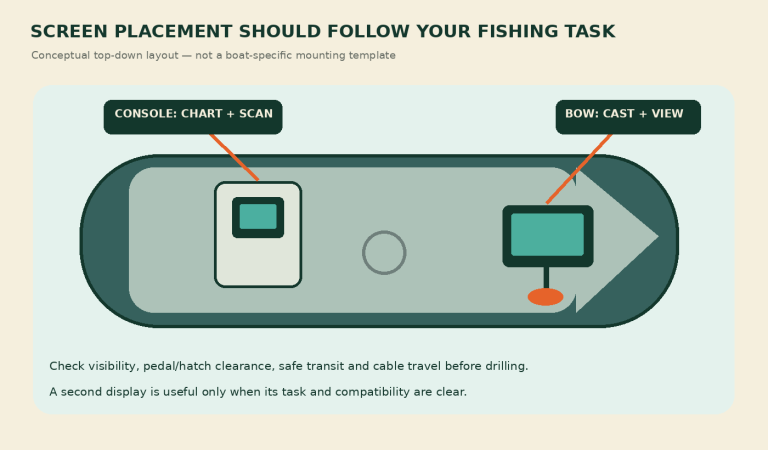
Think about where you’ll stand. At the console you sit close to the screen. At the bow you’re standing over the fish finder with a rod in your hand, often in sun and spray. A screen that looks big in the box looks smaller from up there. That’s why many bass boats run a 12 inch or larger unit at the bow and a second unit at the console.
The usual advice by boat:
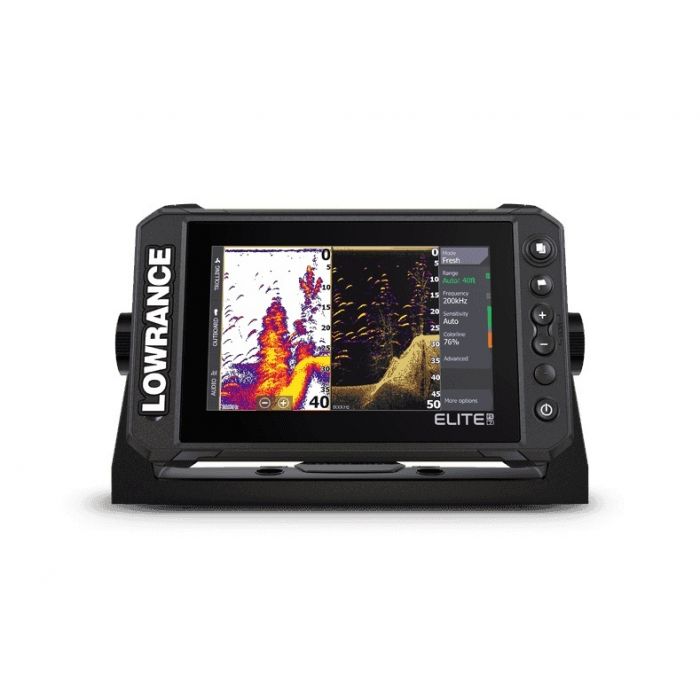
- Jon boat or small tiller boat: a 7 inch fish finder like the Lowrance Elite FS 7 is enough for depth, 2D and down imaging.
- Bass or walleye boat, console: 9 to 12 inch, with side imaging.
- Bow with live sonar: 10 inch minimum, 12 inch or bigger if you can fit it.
- Two screens: keep both the same brand so they can network and share waypoints.
Check resolution as well as size. The Humminbird APEX screens are 1920 x 1080. The XPLORE 9 is 1280 x 720, and the Lowrance Elite FS 10 and 12 are 1280 x 800. Sun matters too. Lowrance says its HDS PRO SolarMAX HD screen can be read through polarized sunglasses, and Humminbird says the same about the XPLORE.
Maps, GPS and networking
Built-in maps and GPS
Every combo fish finder we sell has internal GPS. Most now come with detailed lake maps preloaded or on an included card, so you can mark a brush pile and drive straight back to it.
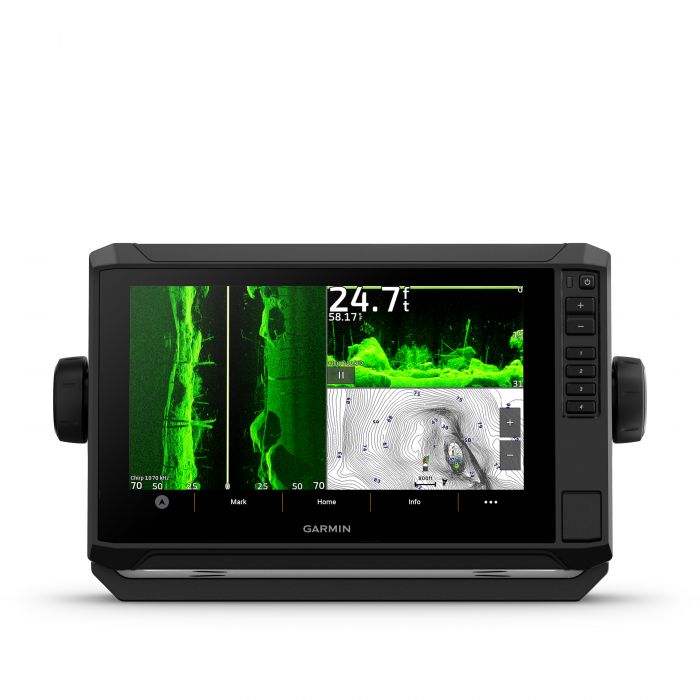
- Garmin: the ECHOMAP UHD2 93sv comes with Garmin Navionics+ U.S. inland charts, the 94sv with U.S. coastal. The ECHOMAP Ultra 2 has inland and coastal, with a year of daily updates through the ActiveCaptain app.
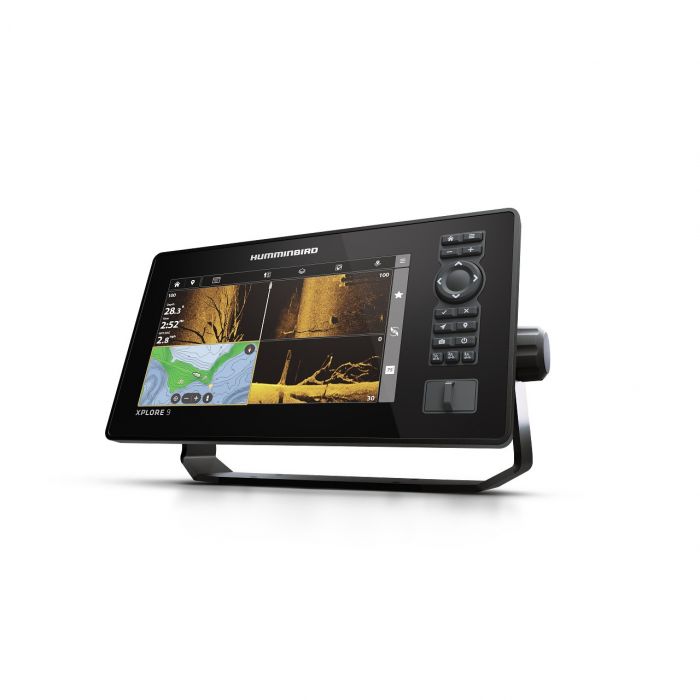
- Humminbird: the XPLORE includes a LakeMaster and CoastMaster VX card. Humminbird says it covers more than 13,000 lakes, waterways and coastal waters in the US and Canada.
- Lowrance: the Elite FS 7 and 9 have C-MAP Contour+ preloaded. The Elite FS 10, 12 and HDS PRO have C-MAP DISCOVER OnBoard with 1 ft contours.
All three brands can also draw your own depth map as you drive. Garmin calls it Quickdraw Contours, Humminbird calls it AutoChart Live (8 hours of recording built in), and Lowrance calls it C-MAP Genesis Live. On a lake with poor charts, your own map can beat the stock one.
Mounting a fish finder in the dash changes things. Humminbird says in-dash installs of the XPLORE and APEX need an external GPS antenna. Lowrance sells the POINT-1 GPS antenna ($324.99) for the same job.
Networking and a second screen
Networking lets two fish finder screens share sonar, maps and waypoints. It’s also how live sonar and other add-ons connect, so check the ports before you buy.
- Garmin: the ECHOMAP UHD2 9 inch has one Garmin Marine Network port. The ECHOMAP Ultra 2 126sv and the GPSMAP 1243xsv have two. UHD2 and Ultra 2 units can also share sonar, waypoints and routes over Wi-Fi. Garmin says LiveScope can’t be shared that way on the UHD2.
- Humminbird: the APEX has two Ethernet ports plus HDMI in and out. The AS ETH 5PGL switch ($329.99) adds ports when you run several units and accessories.
- Lowrance: the Elite FS was the first Elite with Ethernet. The HDS PRO 12 spec sheet lists two Ethernet ports and up to six displays on one network.
NMEA 2000 is the other network. It carries engine data, GPS antennas and trolling motor control. The Lowrance Ghost and Recon both talk to Lowrance screens this way.
Transducer choice and mounting
The transducer matters as much as the fish finder itself. A good screen can’t fix a transducer sitting in turbulent water behind a strake or a livewell pickup. Most combos come with a transom-mount transducer, and that’s the right starting point for an outboard boat.
There are three common spots:
- Transom: the usual install. Humminbird’s XM 14 HW transducer, Garmin’s GT56UHD-TM and Lowrance’s Active Imaging 3-in-1 all mount here.
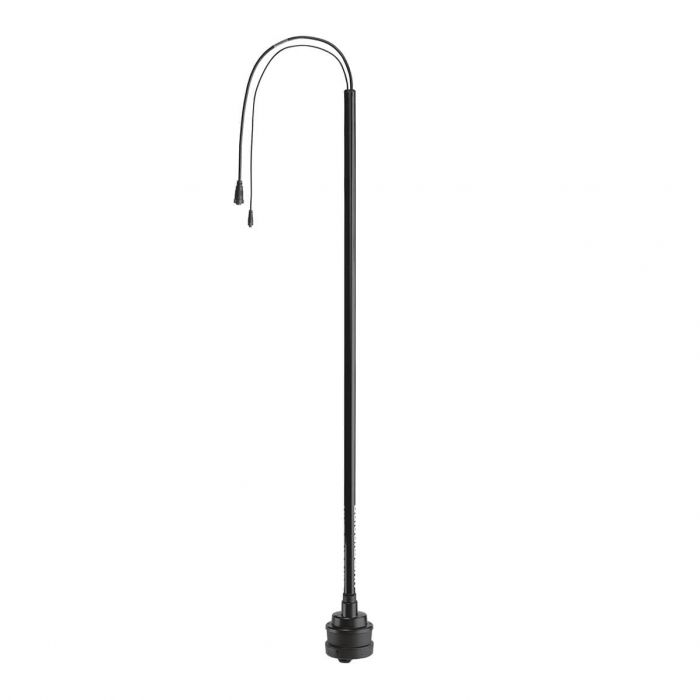
- Trolling motor: puts sonar under the bow where you fish. Garmin includes trolling motor hardware with the GT56UHD-TM, and the Lowrance Ghost and Recon take sonar nosecones in the motor itself.
- Thru-hull: common on larger offshore boats. It’s a bigger install and usually a job for a marine electronics shop.
Before you buy a transducer on its own, run through this list:
- Match the connector. Garmin’s GT36UHD-TM and GT56UHD-TM are 12-pin. The Lowrance Active Imaging HD 3-in-1 uses a 9-pin XSONIC plug.
- Match the sonar types. The GT36UHD-TM ($499.99) does ClearVü and SideVü but not traditional CHIRP. The GT56UHD-TM ($599.99) does all three.
- Check cable length. Both the GT56UHD-TM and the Lowrance Active Imaging HD 3-in-1 have 25 ft cables. Long boats may need an extension.
- Price it against a combo. The Elite FS 9 is $969.99 without a transducer and $1,119.99 with the Active Imaging 3-in-1. That transducer alone is $409.99.
Best fish finder for your budget
These are examples from our shop at today’s prices. Each one includes a transducer and has GPS and maps.
| Budget | Example | Price | What you get |
|---|---|---|---|
| Under $1,000 | Lowrance Elite FS 7 with Active Imaging 3-in-1 | $969.99 | 7 inch, CHIRP, DownScan, SideScan, C-MAP Contour+ |
| $1,000 to $1,500 | Garmin ECHOMAP UHD2 93sv with GT56UHD-TM | $1,299.99 | 9 inch, CHIRP, ClearVü, SideVü, Navionics+ inland, LiveScope support |
| $1,000 to $1,500 | Humminbird XPLORE 9 CMSI+ | $1,499.99 | 9 inch at 1280 x 720, MEGA Side and Down Imaging+, map card |
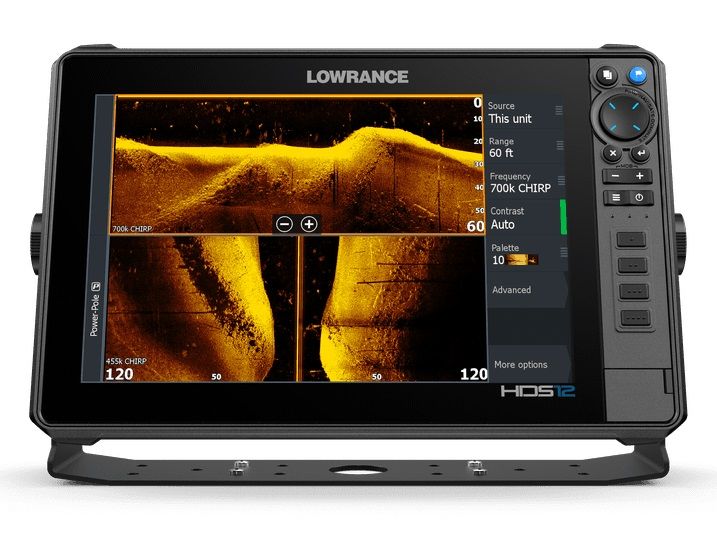
| $1,500 to $2,500 | Lowrance HDS PRO 9 with Active Imaging HD | $1,899.00 | 9 inch, imaging up to 1.2 MHz, ActiveTarget 2 ready |
| $2,500 to $5,000 | Garmin ECHOMAP Ultra 2 126sv with GT56UHD-TM | $3,299.99 | 12.1 inch at 1280 x 800, two network ports, inland and coastal charts |
| $2,500 to $5,000 | Lowrance HDS PRO 12 with Active Imaging HD | $3,369.99 | 12 inch at 1280 x 800, two Ethernet ports |
| Over $5,000 | Humminbird APEX 19 MSI+ | $5,299.99 | 18.5 inch at 1920 x 1080, dual Ethernet, HDMI |
Spend the most on the screen you’ll look at most. If you plan to add live sonar within a year, buy a fish finder that supports it now rather than replacing it later. If you never fish the bow, a mid-size side imaging fish finder at the console is enough.
How to read a fish finder
A fish finder screen is a history, not a snapshot. The right edge is now, and everything to the left already passed under the boat.
Fish arches
A fish shows as an arch because the distance to it changes as the boat passes over. It’s farther away when it enters the beam, closest when it’s straight below, and farther again as it leaves. The middle of the arch is thickest because the echo is strongest there.
Wider beams and lower frequencies draw bigger arches. Garmin says that makes them better for locating fish, while higher frequencies show more detail. Bait often shows as a tight, irregular ball when predators are around, or a thin horizontal line when it’s calm. A nearly vertical line is usually your lure falling.
Bottom hardness
A hard bottom such as rock, gravel or shell returns a stronger echo than mud or silt, so it shows brighter. Garmin has a setting called Edge that highlights the strongest signal from the bottom to help show whether it’s hard or soft.
The usual advice is to look for the spot where a soft bottom turns hard, rather than fishing the middle of a big mud flat.
Thermocline
In summer many lakes stratify. Warm, lighter water sits on top of colder, denser water, and the boundary between them is the thermocline. Garmin notes that thermocline definition can be better at higher frequencies, and on a 2D screen it can show as a faint band at the same depth all the way across.
Oxygen drops below the thermocline as summer goes on, because that water never mixes back to the surface. The usual advice is to fish at or above it. Finding that band tells you which part of the water column to fish.
Clutter and noise
Clutter near the top of the screen is surface noise. Garmin notes that lower frequencies pick up more of it in rough water. Its Surface Noise setting hides it, Color Limit hides weak clutter, and Interference reduces the effect of nearby noise sources.
- Start with the fish finder on auto and change one setting at a time.
- If the screen is full of noise at speed, check the transducer mounting before you blame the fish finder.
- Turn fish symbols off for a while. Garmin’s manual says the symbol setting decides how the sonar interprets suspended targets, and you’ll learn more from the raw arches.
- Try the A-Scope. Garmin describes it as a vertical flasher on the right side that shows the range to targets right now.
Garmin lists every sonar appearance setting in its online owner’s manual, and the same ideas apply to the other brands.
Which fish finder we’d pick
These are the fish finder setups we’d point most customers toward. All are in our graphs category.
- Small boat, tight budget: the Lowrance Elite FS 7 with Active Imaging 3-in-1 at $969.99. It has side imaging and Ethernet for under $1,000.
- Console unit on an inland boat: the Garmin ECHOMAP UHD2 93sv with transducer at $1,299.99, or the Humminbird XPLORE 9 CMSI+ at $1,499.99.
- Bow unit for live sonar: the Lowrance HDS PRO 12 with Active Imaging HD at $3,369.99 plus ActiveTarget 2, or the Garmin ECHOMAP Ultra 2 126sv at $3,299.99 plus LiveScope.
Match the fish finder to your trolling motor where you can. Garmin Force motors connect to Garmin units. The Ghost and Recon connect to Lowrance. Humminbird pairs with Minn Kota motors over its One-Boat Network, and we don’t sell Minn Kota. Our brand guides go deeper: Garmin, Lowrance and Humminbird.
Gear in this guide
Questions about fish finders
What is the best fish finder for a small boat?
For a jon boat or small tiller boat, a 7 inch fish finder with down imaging is plenty. The Lowrance Elite FS 7 starts at $764.99 without a transducer and $864.99 with an HDI transducer for CHIRP and DownScan.
Is a side imaging fish finder worth it?
Yes, if you fish structure or new water. Side imaging finds brush, rock and humps off to the sides that a down view never passes over. If you only troll open water for suspended fish, 2D and down imaging cover most of what you need.
Can I put a fish finder transducer on my trolling motor?
Yes. Garmin includes trolling motor hardware with the GT56UHD-TM, and Lowrance sells a 9-pin 83/200 kHz trolling motor transducer ($95) for 2D sonar. The Ghost and Recon take sonar nosecones built into the motor.
Can I mix brands on one boat?
You can run two brands side by side, but they won’t share sonar with each other. Live sonar is locked to its brand as well. Most people keep the whole boat on one brand.
Do I need a fish finder with GPS?
You don’t need it to see fish, but you’ll want it. GPS lets you save a waypoint on a brush pile and come back to it, and every combo fish finder in this guide has it built in along with lake maps.
What does CHIRP mean on a fish finder?
CHIRP sonar sweeps each pulse through a band of frequencies instead of one fixed frequency. Garmin says this gives better target separation, so fish close together show as separate marks.
Ask us before you order
Electronics are final sale, so check compatibility first. Email sales@trollingmotorsdirect.org with your boat, trolling motor and current fish finder, and we’ll tell you what fits. We answer Monday to Friday, 9am to 6pm.