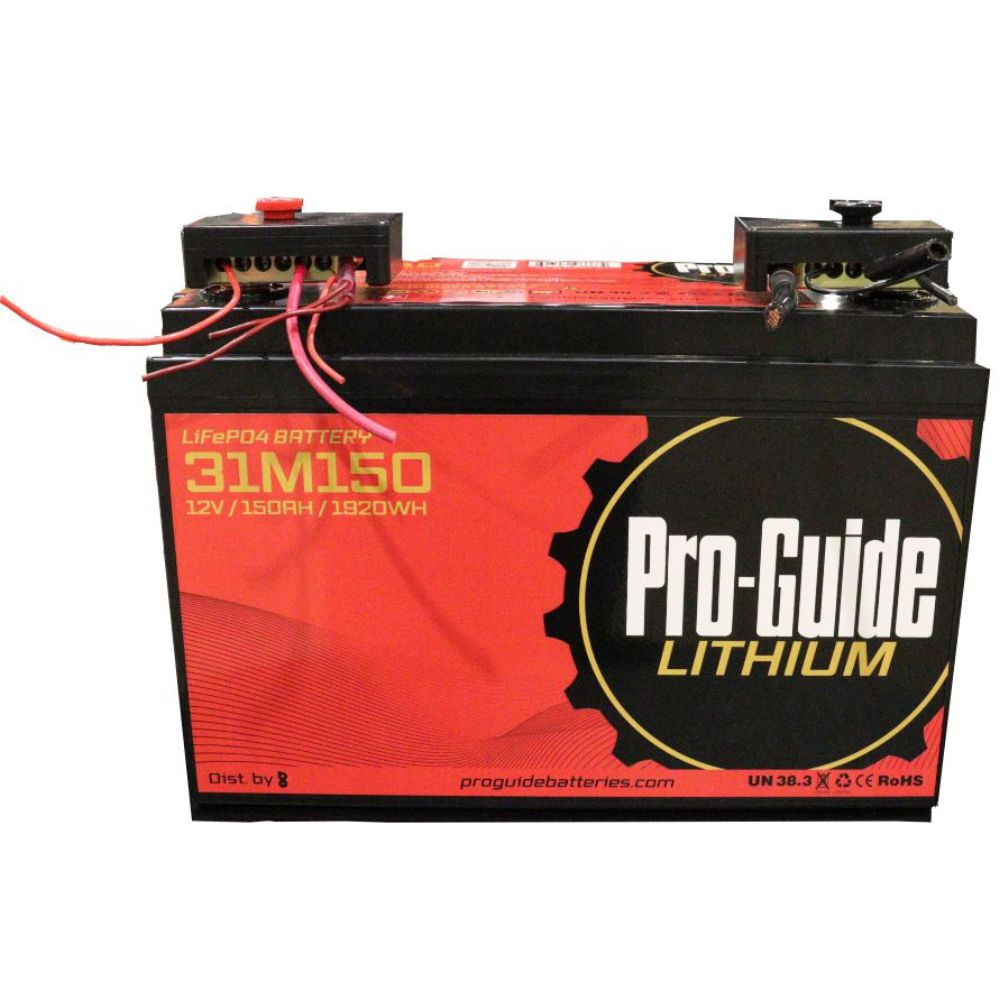
A trolling motor battery has to be a deep cycle battery, matched to your motor’s voltage, with enough amp-hours to get through your longest day on the water. For the motors we sell, that means a 24V or 36V bank: two or three 12V batteries wired in series, or one 24V or 36V lithium battery. We don’t sell batteries, so this is about choosing and sizing one, not about a brand we stock.
Deep cycle vs cranking: what a trolling motor battery has to do
A cranking (starting) battery is built to push a lot of current for a few seconds to turn over an outboard. That’s why it’s rated in cold cranking amps (CCA). A trolling motor pulls a steady load for hours, and that’s the job a deep cycle battery is built for.
Some batteries carry both ratings and get sold as dual purpose. Odyssey’s group 31 AGM, for example, lists 1,150 CCA and 103 Ah. Those can work, but the amp-hour figure is the one that matters for the trolling motor.
A car battery is a cranking battery. It will spin a trolling motor for a while, but it isn’t designed to be run down day after day.
Keep the cranking battery separate
Minn Kota’s battery and wiring guide says that if you start a gas outboard with a crank battery, the trolling motor should get its own deep cycle battery or batteries. Drain the trolling bank fishing a long flat and you still want the big motor to start for the ride home.
The same goes for electronics. Graphs and live sonar are usually run from the cranking or a separate house battery, not from one battery in the trolling bank. Taking 12V off one battery in a series bank drains it faster than the others.

Flooded, AGM or lithium
You’ll see three chemistries in boat batteries. All three work with a trolling motor. They differ in upkeep, weight, price and how much of the rated capacity you can use.
- Flooded lead-acid: the cheapest up front. The cells have caps and need distilled water topped up. They give off gas while charging, so mount them in a ventilated compartment (Minn Kota’s guide asks for ventilation with any battery).
- AGM (absorbed glass mat): still lead-acid, but sealed and spill-proof, with no watering. It costs more than flooded. A good fit if you want lead-acid without the maintenance.
- Lithium (LiFePO4): much lighter and rated for thousands of cycles. It costs more up front, needs a charger with a lithium setting, and most can’t be charged below freezing unless they have a built-in heater.
| Question | Flooded | AGM | Lithium (LiFePO4) |
|---|---|---|---|
| Routine upkeep | Check and top up water | None | None |
| Sealed | No | Yes | Yes |
| Usual depth of discharge | About 50% | About 50% | Most of the rating |
| Example cycle rating | Varies by maker | Odyssey group 31: up to 400 at 80% | Battle Born 100 Ah: 3,000 to 5,000 at 100% |
| Charger setting | Flooded profile | AGM profile | Lithium profile |
The usual advice for lead-acid is to stop at about 50% discharge if you want it to last. Odyssey rates its group 31 AGM for up to 400 cycles at 80% depth of discharge. Battle Born rates its 100 Ah lithium for 3,000 to 5,000 cycles at 100%. We go deeper on weight, cold charging and cost per cycle in our lithium trolling motor battery guide.
Group sizes and amp-hours
Group size is a case-size standard from the Battery Council International. It tells you whether a battery fits your tray and hold-down. It doesn’t tell you how good the battery is. For trolling motors, the common sizes are 24, 27 and 31.
| Group size | Typical capacity | Minn Kota runtime rating |
|---|---|---|
| Group 24 | 70 to 85 Ah | Good |
| Group 27 | 85 to 110 Ah | Better |
| Group 31 | 95 to 125 Ah | Best |
The figures above come from Minn Kota’s battery and wiring installation sheet. The same sheet says that for best results you should use a deep cycle marine battery with at least a 110 amp-hour rating. On a boat with group 31 trays, you can hit that. On a smaller boat, a group 27 may be the biggest that fits.
Lithium blurs group sizes. A 100 Ah lithium battery can come in a smaller case than a 100 Ah AGM. Battle Born sells its 100 Ah battery as a drop-in for group 27 and group 31 compartments. Measure your tray, the hold-down and the lid clearance before you order anything.
Why the Ah on the label isn’t the whole story
Lead-acid amp-hour ratings are measured at the 20-hour rate. A 100 Ah battery is tested by pulling about 5 amps for 20 hours. Pull harder and you get less out of it.
Odyssey’s group 31 AGM shows this. It’s rated 103 Ah at the 20-hour rate and 220 minutes of reserve capacity. Reserve capacity is minutes at a steady 25 amps, so 220 minutes works out to about 92 Ah. Same battery, a heavier load, roughly 11 Ah less.
Runtime math for a trolling motor battery
The math is simple. Usable amp-hours divided by average amps equals hours. The hard part is knowing your average amps.
How many amps a trolling motor really draws
Here’s what the makers publish for maximum draw. Minn Kota’s sheet lists 50 A for its 50 and 55 lb 12V motors, 56 A for its 80 lb 24V motor and 52 A for its 112 lb 36V motor. It notes those maximums only happen now and then, under certain conditions.
Garmin’s Force Pro and Force Kraken manuals say the battery bank must be able to supply 60 A continuously. Garmin lists full power at 36V and 60 A as 2,160 watts. Lowrance lists the Recon’s maximum draw as 55 A at both 24V and 36V.
A trolling motor’s real draw on a fishing day is lower than those peaks, and it moves around. It rises with throttle, wind, current and boat weight. Holding spot-lock in a stiff wind uses far more than easing down a bank on a calm morning.
A runtime table with stated assumptions
The table below uses three stand-in loads and these assumptions:
- Lead-acid (flooded or AGM): 100 Ah rated per battery, and you stop at 50%, so 50 Ah usable.
- Lithium: 100 Ah rated per battery, and you keep 10% in reserve, so 90 Ah usable.
- Losses: ignored. Lead-acid at 50 A will fall short of these numbers, as the reserve capacity example above shows.
- Series banks: two or three 100 Ah batteries in series are still 100 Ah, just at 24V or 36V.
| Battery bank | Usable Ah | Hours at 10 A | Hours at 20 A | Hours at 50 A |
|---|---|---|---|---|
| One 12V lead-acid, 100 Ah | 50 | 5.0 | 2.5 | 1.0 |
| One 12V lithium, 100 Ah | 90 | 9.0 | 4.5 | 1.8 |
| 24V, two 100 Ah lead-acid | 50 | 5.0 | 2.5 | 1.0 |
| 24V, two 100 Ah lithium | 90 | 9.0 | 4.5 | 1.8 |
| 36V, three 100 Ah lithium | 90 | 9.0 | 4.5 | 1.8 |
The hours don’t change with voltage at the same current. What changes is the work you get from each amp. Watts are volts times amps, so 20 A from a 36V bank is three times the power of 20 A from one 12V battery.
That’s why a higher-voltage trolling motor makes more thrust for similar current. Lowrance rates the Recon at 90 lb of thrust on 24V and 110 lb on 36V, with the same 55 A maximum draw.
A worked example at full power
Take a Garmin Force Pro on a 36V bank of three 100 Ah lithium batteries. Using the same 90 Ah usable figure, that bank holds about 3,240 watt-hours (36V times 90 Ah). At Garmin’s full-power figure of 2,160 watts, that’s about 1.5 hours flat out. Nobody fishes that way all day, but it shows why the bank has to be big.
Sizing for your longest day
Size a trolling motor battery bank by working backward from the day you fish hardest. Say you fish 8 hours and guess an average of 15 A. That’s 120 Ah you need to use. With lead-acid stopped at 50%, you’d need 240 Ah rated, more than any single group 31 battery. With lithium at 90% usable, you’d need about 133 Ah.
Your 15 A guess could be off in either direction. Add a margin, because every battery loses some capacity as it ages. If the math says you’re close, go up a size.
Matching the bank to 12V, 24V or 36V
Every trolling motor is built for a set voltage or voltages, and the battery bank has to match. A 12V motor runs from one 12V battery. A 24V motor needs two in series, and a 36V motor needs three.
All four motors we sell, the Garmin Force Pro, Garmin Force Kraken, Lowrance Ghost and Lowrance Recon, run on either 24V or 36V. None of them runs on 12V. If you’re moving up from a 12V motor, our 24 volt trolling motor guide walks through the series wiring step by step.
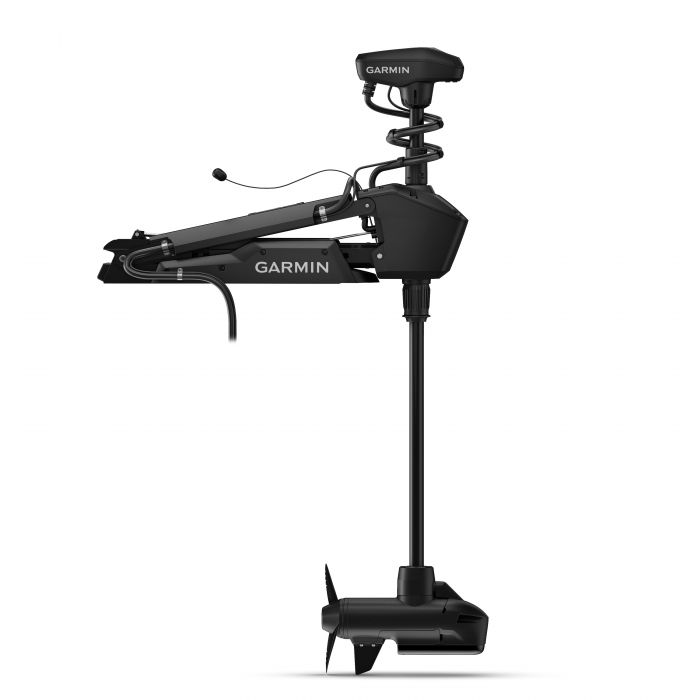
Series wiring adds voltage, not amp-hours. Two 100 Ah batteries in series give you 24V at 100 Ah. Parallel wiring does the opposite, adding amp-hours at the same voltage, and it won’t run a 24V or 36V motor.
Every battery in a trolling motor bank should be the same make, type, size and age. Minn Kota’s guide spells that out, and the Lowrance Recon manual says not to mix battery types in a series string.
Charging and storing trolling motor batteries
Onboard chargers
An onboard charger is the easy way to do it. It mounts in the boat, plugs into shore power with one cord, and has a separate output, called a bank, for each 12V battery. A 36V bank of three 12V batteries needs a three-bank charger.
Match the charger to the chemistry. Flooded, AGM and lithium batteries want different charge voltages. Battle Born, for example, lists 14.2 to 14.6V absorption and 13.4 to 13.8V float for its 12V lithium. If your charger has selectable profiles, set each bank to match its battery.
Charge your trolling motor batteries after every trip. Minn Kota’s guide says failing to recharge lead-acid batteries within 12 to 24 hours is the leading cause of early battery failure. It also says to disconnect the motor while the batteries charge.
A bank built from one 24V or 36V lithium battery is different. It needs a charger made for that voltage and chemistry, not a multi-bank 12V charger.
Storing and caring for trolling motor batteries
- Store them charged: Minn Kota’s guide says to store batteries at full charge, so charge fully before a layup.
- Disconnect the bank: unplug the motor or turn off the breaker so nothing slowly draws it down.
- Check flooded cells: keep the water at the level the maker shows, using distilled water only.
- Lithium storage: Battle Born says to charge to 100% and disconnect completely. Its data sheet lists self-discharge of 2 to 3% a month and says the battery should still be 75 to 80% charged after six months.
- Temperature: the same sheet lists a storage range of -10°F to 140°F and warns that subzero storage can crack the case. Check your own battery’s limits.
- Terminals: keep posts clean and connections tight, as Minn Kota’s guide says.
Signs your trolling motor batteries are wearing out
Wear usually shows up as shorter runtime before anything else. It shrinks a little each season until one day the trolling motor slows down by early afternoon on a trip it used to handle easily.
- Shorter days: same water, same wind, and you’re out of power sooner than last year.
- One battery out of step: after a full charge, one battery in the bank reads lower than the others on a meter. In a series bank, the weak one drags the rest down.
- Physical damage: a swollen or cracked case, leaking acid or melted terminals. Replace it and find out why it happened.
- Charger never finishes: an onboard charger that keeps one bank in bulk mode long after the others are done.
When one battery in a series bank is done, the usual advice is to replace the whole set so they’re the same age again.
Wiring, breakers and terminals
A trolling motor battery is only as good as the wire between it and the motor. Undersized wire or a loose lug turns power into heat, and the motor sees less voltage than the battery is putting out.
Every motor we sell calls for a breaker on the power feed. The Force Pro installation manual and the Force Kraken manual call for a breaker rated 60 A continuous. The Lowrance Recon manual calls for a 60 A manual-reset breaker in the positive cable, no more than 6 ft from the batteries. The Ghost manual we have, from 2020, lists 50 A at 24V or 36V. Use the figure in the manual that came with your motor.
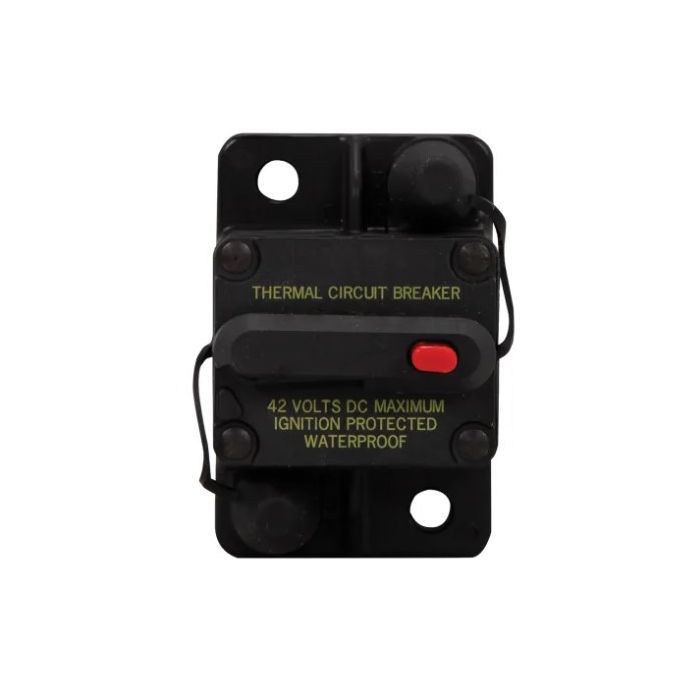
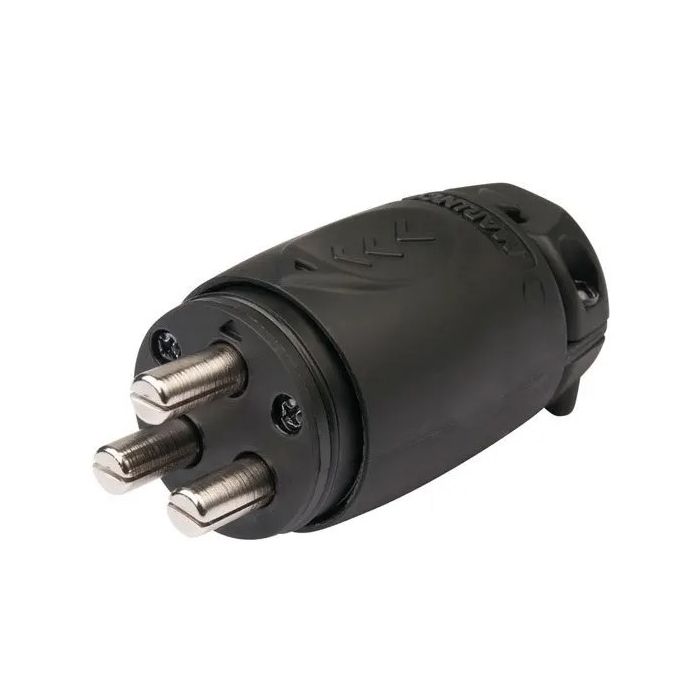
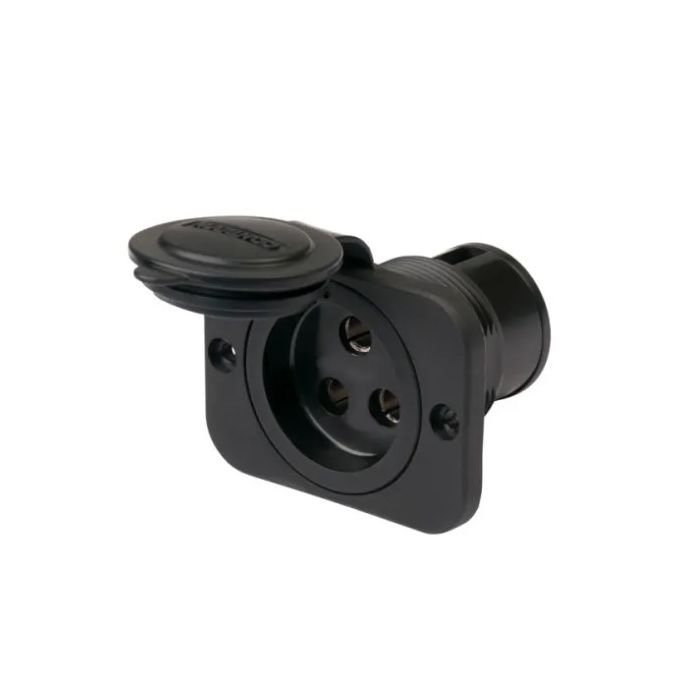
For Force motors we carry the Garmin 60A Circuit Breaker ($89.99), the Garmin 70A Power Plug ($49.99) and the matching 70A receptacle ($49.99). Garmin asks for a plug and receptacle rated 60 A or more, so the 70 A pair clears that.
At the battery end, clean and tight terminals matter as much as wire size. If yours are corroded or you’re redoing the bank, we sell a Battery Terminal Set ($99.99). Wire gauge by length, plug installation and breaker placement are covered in our trolling motor plug guide.
Which trolling motor battery setup we’d pick
We don’t sell batteries, so there’s no brand for us to push. These are the setups we’d point a friend toward, based on how they fish.
- Weekend boat, tight budget: flooded or AGM deep cycle batteries in group 27 or 31, at least 110 Ah if they fit. It’s the cheapest way in. They’re heavy, and you’ll replace them sooner.
- Tournament or all-day fishing: lithium, 100 Ah per 12V battery or bigger, on a charger with a lithium profile. It costs the most up front and saves the most weight.
- Small boat where weight is a problem: a single 24V or 36V lithium battery, as long as its continuous rating covers your motor’s draw.
- Every setup: a separate cranking battery for the outboard, a breaker sized from the motor manual, and a plug rated above the breaker.
For the trolling motor itself, all four of ours run on 24V or 36V. The Lowrance Ghost ($3,199.00) is our lowest-priced motor. The Lowrance Recon ($3,669.99) and both Garmin Force motors are on our trolling motors page.
Gear in this guide
Questions about trolling motor batteries
How long does a 12 volt trolling motor last on one battery?
It depends on the draw. Minn Kota lists up to 50 A for its 55 lb 12V motors at full throttle. A 100 Ah lead-acid battery used to 50% gives you about an hour at that rate and around five hours at 10 A. A 100 Ah lithium gives you a bit under twice that.
What is the best trolling motor battery?
There’s no single best trolling motor battery for every boat. The right one fits your tray, matches your motor’s voltage, holds enough amp-hours for your longest day and fits your budget. For all-day fishing with a 24V or 36V motor, lithium makes the most sense if you can afford it.
Can I run the trolling motor off my starting battery?
You shouldn’t. Minn Kota recommends separate deep cycle batteries for the trolling motor when a crank battery starts the outboard. A starting battery run flat leaves you without the big motor.
What size trolling motor battery do I need?
Start with Minn Kota’s guideline of at least 110 Ah, then check what fits your tray. Group 31 batteries typically run 95 to 125 Ah, group 27 85 to 110 Ah, and group 24 70 to 85 Ah. You need one 12V battery for every 12 volts of motor, unless you use a single 24V or 36V lithium.
How many trolling motor batteries do I need for 36V?
Three 12V batteries wired in series, or one 36V lithium battery. A 24V trolling motor needs two 12V batteries or one 24V lithium. The cranking battery for the outboard is extra.
Does a trolling motor battery bank need a circuit breaker?
Yes. Garmin, Lowrance and Minn Kota all call for a breaker or fuse on the power feed. Size it from your motor’s manual: 60 A for the Garmin Force motors and the Recon.
Ask us about your setup
Email sales@trollingmotorsdirect.org (Monday to Friday, 9am to 6pm) with your boat, your motor and your battery tray sizes, and we’ll tell you what we’d run.