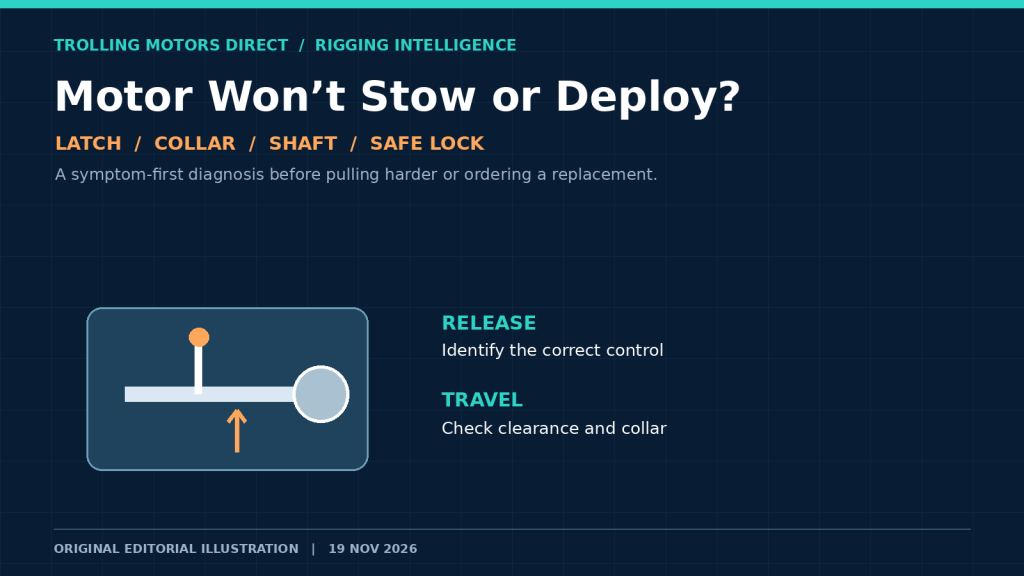
If your trolling motor won’t stow or deploy, the problem may involve the release latch, pull cable, shaft alignment, depth collar, or mounting mechanism. Identifying the exact symptom before applying force can help prevent additional damage.
The last cast is finished, the wind is pushing toward the ramp, and the trolling motor refuses to come up. You pull harder. It moves an inch, then jams. The temptation is to blame the motor or yank the release handle again—but a mount that will not release, a shaft that will not align, and a motor that will not lock safely for travel are three different problems. Treating them as one can turn an annoying dockside delay into a damaged mount or a dangerous accidental deployment on the road.
This guide is a calm, symptom-first way to distinguish those failures. It concentrates on the manual stow-and-deploy mechanisms relevant to Garmin Force Pro, Garmin Force Kraken, Lowrance Ghost, and Lowrance Recon. Their control hardware differs, so the correct next action depends on the model. The goal is not to encourage improvised repairs. It is to help you observe the right clues, perform non-invasive checks, and know when to stop and involve a qualified technician.
Safety first: Keep everyone clear of the propeller and all pinch points. Maintain stable footing and support the motor’s weight. Never travel with a motor that does not positively lock and secure as its manufacturer requires. Turn off and isolate electrical power before any inspection involving a propeller, internal latch components, wiring, or disassembly, unless the manufacturer expressly requires a powered state for a normal stowing procedure. Do not test a prop out of water.
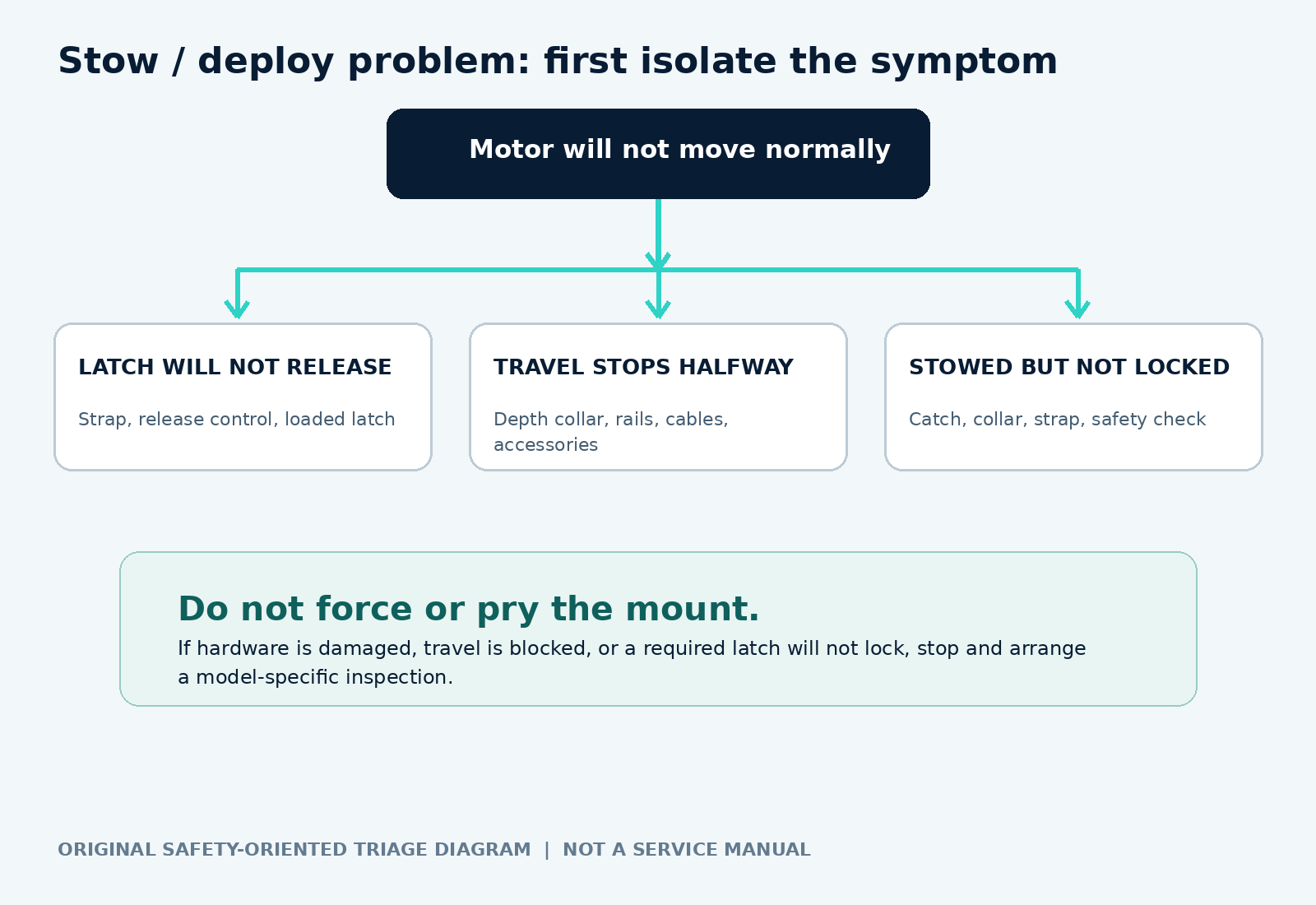
The three failures that feel like one stuck motor
Failure one: the latch will not release
The first clue is a release handle, pull cable, or foot lever that operates differently from normal. Perhaps it feels slack, unusually hard, gritty, or does not produce the familiar release. The motor stays in its cradle even though you have followed the operator manual’s proper release method.
The likely category is release actuation, latch loading, or a mechanical obstruction; the exact defective part cannot be diagnosed by feel alone. A loaded bracket may bind because the motor is being pushed against it by gravity or boat motion. A snagged strap, accessory bracket, cable loop, or object under the mount can also prevent normal travel. Resist the urge to pry the mechanism open: what looks like a stubborn latch may be a warning that the shaft is not supported or the bracket is misaligned.
Failure two: the motor releases but will not travel freely
Here the latch actually opens, but the assembly jams partway through its arc. That points the inspection toward depth collar position, shaft clearance, mount rails, stabilizers, deck accessories, and transducer or power cables. A shaft can be correctly set for fishing depth yet incorrectly positioned for resting on the mount. Another common complication is a newly added sonar pole or bracket that only clears when deployed.
The motor itself may be healthy. A changed cable route, a loose bracket, a too-tall stabilizer, or an obstruction under the mount can create a travel problem that appears immediately after a boat-rigging change. The right response is to identify where the motion stops, not to force the assembly through that point.
Failure three: it stows, but does not lock or stay secured
This is the most serious category for a trip home. A motor that settles onto its cradle without a firm latch can launch unexpectedly in rough water or while trailering. Do not use the hold-down strap to disguise an unlatched mechanism unless the manufacturer expressly states that arrangement is sufficient. Different models rely on different combinations of mechanical catches, collars, braces, and straps.
Garmin specifically warns Force Kraken owners to verify the motor is locked by pushing and pulling along the shaft after stowing, and to position the depth collar near the motor base. The Force Pro has a separate instruction to secure its safety strap. Minn Kota’s October 21, 2026 safety guidance likewise emphasizes that collars and straps can prevent unintended deployment, with exact requirements depending on model.
| What you observe | First check, without forcing anything | Why it matters | Stop condition |
|---|---|---|---|
| Release feels slack or disconnected | Inspect visible handle/cable/lever route against manual | Actuation may not be reaching latch | Broken, frayed or detached parts |
| Release operates but motor will not move | Check strap, motor support, nearby obstruction | Latch may be loaded or bracket blocked | Requires prying or extra force |
| Motor travels halfway then stops | Inspect depth collar, shaft, rails, pole and cable clearance | Moving geometry changes through arc | Shaft or wire is being crushed |
| Stowed motor does not click/hold | Confirm catch engagement per exact manual | Travel safety depends on a secure latch | Cannot prove positive lock |
| Stow causes unexpected steering movement | Review model’s specified motor orientation | Some systems rotate lower unit for stowing | Steering does not settle as manual describes |
| Motor redeploys while underway | Stop operation and secure vessel safely | Immediate injury and damage risk | Any unexplained release is a service issue |
A five-minute inspection before touching tools
Confirm the exact model and position
Write down the brand and series. “Garmin Force” is not enough, because the Force Pro’s scissor-style mount and Force Kraken’s pivot mechanism follow different stow instructions. The same distinction applies to Lowrance Ghost and Recon. Photograph the unit while it is safely supported, including the release mechanism and depth collar; pictures help a technician distinguish a binding bracket from a mistaken operating sequence.
Next identify whether the motor is fully deployed, partway up, or fully resting on the mount. Never begin a check by activating thrust. Shut down the propeller, keep people out of the water around the motor, and do not place fingers between the mount and shaft. If an inspection will involve mechanical parts, isolate power first according to the manufacturer’s safety directions.
Look for the simplest external obstruction
Is a stow strap still fastened? Is a fishing rod, bow cleat, deck latch, anchor line, transducer pole, cable clamp, or accessory interfering with travel? A soft cable loop trapped beneath an arm can stop the motion just as decisively as a damaged latch. Inspect without pulling or tugging on the cable. Where accessible, check whether the stabilizer is in the correct position and whether the motor has enough clearance from the gunwale.
If the problem started after you installed LiveScope, MEGA 360, a sonar pole, or a stabilizer, that chronology is useful diagnostic evidence. Photograph the new hardware and the point at which it approaches the mount. Do not remove a load-bearing accessory while a heavy motor is unsupported. Instead, support the assembly and refer the installation to a competent rigging professional if access is uncertain.
Read the model’s normal release procedure again
A release that works by pulling a cable is not operated the same way as one released by a foot lever. Even among cable-pull motors, the handle orientation and motor’s resting position matter. Use the manufacturer’s owner’s manual, not an improvised tutorial that assumes all bow mounts have the same latch architecture.
Garmin Force Pro: check the cable handle, rails, and safety strap
What Garmin tells you to do
Garmin’s Force Pro deployment instructions start by releasing the safety strap, pulling the latch cable back until it stops, then lifting and lowering the motor carefully into the deployed position. It may require pressing down on the mount arm to lock the deployed position.
When returning it to stow, Garmin says to let the drive motor complete its movement to one side before raising it. It also says to hold the release handle perpendicular to the pull cable to reduce wear. The motor must rest on the mount’s rails; incorrect depth adjustment can make the motor press on a gas spring or hang off the base. Finally, the steering housing should lock and the safety strap must be secured. These instructions are contained in Garmin’s Force Pro stowing guide.
How to interpret what goes wrong
If the handle will not release the latch, first check whether the strap is still holding the assembly and whether the pull cable is routed as designed. If the motor releases but will not lie properly on the rails, focus on the depth setting and whether a new bracket or wire is obstructing travel. If it reaches the rails but will not lock, stop there rather than using the strap as a substitute for a positive catch.
Garmin provides a specific depth-collar procedure. It involves setting the unit halfway between deployed and stowed and securing the collar correctly; the motor may slide when the collar is released. That is not a casual dockside repair with a drifting boat. Follow the complete instructions with the motor supported and a safe working position.
Do not confuse a normal motor orientation adjustment with a mechanical latch fault. Observe whether the lower unit finishes moving before stow, but do not place your hand in the steering mechanism to force the angle.
Garmin Force Kraken: a different latch and collar sequence
Release the pedal, then guide the shaft
Garmin’s Kraken deploying procedure begins by moving the depth-adjustment collar away from the motor housing. You hold down the latch pedal, slide the motor out, then raise it slowly into the deployed position. The keyed depth mechanism should align with the steering motor, and Garmin warns to check for obstructions if it does not.
That detail matters because a Kraken can resist movement even when the pedal is working. Before declaring a broken latch, compare the shaft and collar position to Garmin’s illustrated instructions and inspect for interference. If anything is bent or the mechanism does not engage normally, stop instead of using the pedal as a lever to force it.
The positive-lock check is not optional
Garmin’s Kraken stowing procedure says the motor should rotate to a stow orientation, then the shaft is tilted and guided into the catch. The manual instructs the operator to push and pull along the shaft to verify the mechanism has locked. The depth collar must be moved near the motor base. If there is a stabilizer, secure it as specified.
Garmin publishes maintenance guidance for the latch pedal and springs. Worn or damaged components must be replaced; they can lead to inadvertent deployment. That is evidence of a possible mechanical failure mode, not permission to dismantle the mount with a suspended motor. If the latch does not reliably lock, treat it as a service matter.
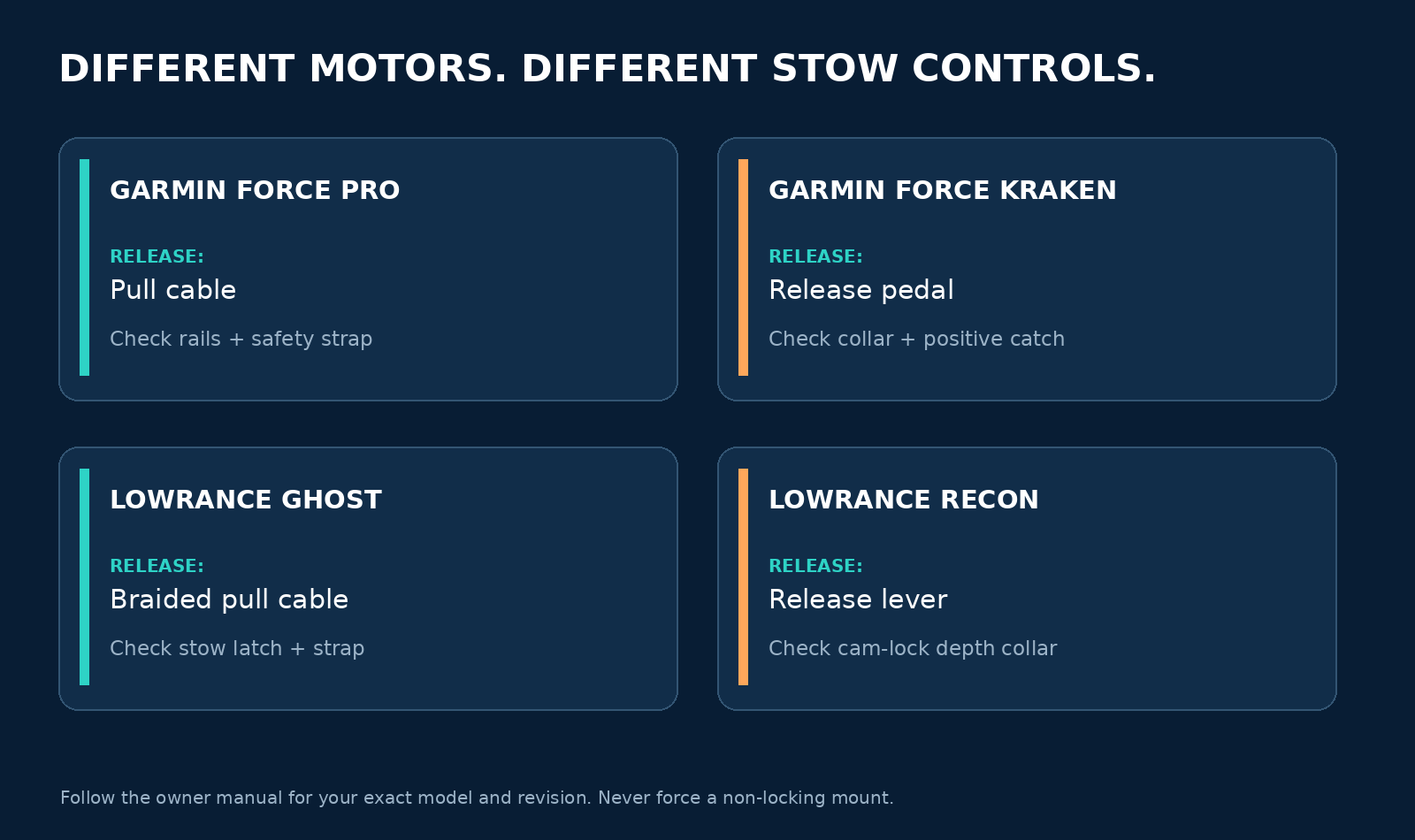
Lowrance Ghost and Recon: avoid applying Garmin instructions
Ghost uses a braided pull cable and stow strap
Lowrance’s Ghost operator documentation identifies a braided stainless-steel pull cable and handle, a stow/deploy assist spring, depth adjustment, and a strap. The motor latches in both the stowed and deployed positions. Lowrance’s published sequence releases the strap and pulls the cable to deploy, then confirms the motor is locked in the water. For stowing, its operator manual calls for the motor to be turned on so the lower unit can orient to the stowing angle; the propeller should remain stopped. It then instructs using the cable to unlatch and guide the assembly onto the deck, checking that the mount locks and securing the strap.
This does not mean you should leave power on while servicing the prop, checking wiring, or dismantling hardware. Normal operation and maintenance are separate procedures. The Lowrance documentation also says to disconnect battery power before cleaning or checking the propeller. Locate your exact manual via Lowrance’s official manuals service before proceeding. An older Ghost operator manual (2020 revision) is available in Lowrance/Navico’s published document archive, but verify its applicability to your serial number and configuration.
If the cable becomes abnormally slack or the mount stops catching, do not assume a universal cable-length adjustment will fix it. Lowrance describes a model-specific pull-cable adjustment procedure, and incorrect work can create a safety problem. Document the symptoms and consult an authorized dealer or installer.
Recon uses a pivot release lever and cam-lock collar
Lowrance Recon is not a Ghost with a different remote. Its documented procedure uses a stow/deploy release lever and a cam-lock depth collar. That means the collar’s position and a clear travel arc deserve special attention when the shaft refuses to move or seat into the cradle. The exact sequence varies with what the motor is doing, and a Recon should not be forced by pulling where a Ghost’s cable handle would be.
A secondary transcription of the Recon operator manual describes moving the collar out of the way before releasing the pivot and returning the collar to its correct stow position once the motor is cradled. Before stowing a Recon, stop the propeller and support the motor as you follow its model-specific release and stow procedure. Once cradled, verify the stow latch is engaged and secure the cam-lock depth collar against the transmission as directed by the applicable Lowrance manual. Because manual revisions and regional configurations can differ, treat that description as orientation, not a substitute for the current official Lowrance Recon manual. Retrieve the model-specific document from Lowrance manuals and confirm the exact steps for your motor before operating it.
| Model | Normal release architecture | Stow security attention | Authoritative reading |
|---|---|---|---|
| Garmin Force Pro | Pull cable, scissor mount | Rails, steering-housing latch, safety strap | Garmin Force Pro owner’s manual |
| Garmin Force Kraken | Foot pedal, pivot/shaft mount | Motor catch, collar position, positive push/pull lock check | Garmin Force Kraken owner’s manual |
| Lowrance Ghost | Braided pull cable, assisted mount | Positive stow latch and stow strap | Lowrance Ghost operator manual |
| Lowrance Recon | Release lever, cam-lock collar | Collar, cradle and secure catch per exact revision | Lowrance Recon operator manual |
Do you need a replacement part, service, or an entirely new motor?
When adjustment and rigging may be the real problem
If the issue appeared immediately after changing a transducer mount, pole, graph bracket, stabilizer, or cable routing, suspect interference before internal failure. Photograph the mechanism from several angles and compare the full arc of motion to a factory-clear assembly. A competent installer can usually determine whether an accessory is contacting the mount without replacing an otherwise working trolling motor.
Likewise, a poorly placed depth collar can prevent the lower unit from resting in its proper stow position. That is a configuration issue until proven otherwise—but the procedure for moving the collar still belongs to the exact owner’s manual. Never loosen a collar that supports a heavy assembly without controlling the load.
When a mechanical inspection is justified
An audible abnormal grinding sound, bent hardware, a frayed cable, a lever that moves with no release, or a catch that refuses to secure after a correct operating sequence warrants professional inspection. For a Kraken, Garmin explicitly describes worn latch pedals, linkages, and springs as replacement conditions. The fact that parts exist does not mean every owner should perform that work without proper training and tools.
A separate electrical symptom may coexist with a stow problem: the steering head may fail to orient for storage, the display may shut off, or a remote may not respond. Do not diagnose that as a broken latch solely because it happened at the ramp. Record the power and error indicators and troubleshoot the electronics according to the correct manual, keeping the propeller disabled while handling the assembly.
When replacement might actually make sense
A full replacement decision comes after a service assessment: persistent structural damage, irreparable mounting damage, repeated unsafe latching, unavailability of compatible parts, or repair expense disproportionate to the remaining life of the motor. It is not justified merely because a cable once bound after adding an accessory. Ask the technician to separate a mechanical mount issue from an electrical steering issue and to identify the exact part or repair needed.
Trolling Motors Direct offers Garmin Force Pro and other trolling motors as commercial options, but the right path may simply be inspection or a replacement mount part. The retailer’s contact page invites shoppers to send model numbers and photos for a fit check. Confirm an item by part number before ordering; the retailer states that electronics are final sale.
A safe before-launch and before-trailer checklist
- Before launch: confirm the motor is secured in its stowed position using its required catch, collar, and strap or stabilizer; no accessory is contacting the mount.
- On the water: deploy only with space, stable footing, and the correct model release procedure; confirm the deployed latch engages before powering the prop.
- During fishing: watch for cable loops that rub or are pinched during repeated steering and depth changes; keep fishing gear off the mount travel path.
- Before stowing: stop thrust, maintain a safe position, and allow any manufacturer-described steering alignment to finish.
- During stow: guide the motor; do not jerk a release cable, pry a catch, or pull on a sonar cable to move the assembly.
- Before transport: verify positive latch engagement, collar placement, and any required strap or stabilizer; if the motor will not lock, do not trailer until it is safely resolved.
- After a problem: record exactly where the motion stopped, what the lever felt like, which accessories were fitted, and whether the motor passed the lock test. Those notes make service faster.
Frequently asked questions
Why won’t my trolling motor lift even though I pulled the release cable?
First confirm that your motor uses that release method, the strap is removed, and the assembly is safely supported. An obstructed or loaded latch, damaged cable, or interference can all feel similar. Do not pull harder until you understand why the latch is resisting.
Is it safe to trailer a trolling motor that rests on the deck but does not click into the catch?
No. If the manufacturer requires a positive lock and you cannot verify it, the motor may deploy unexpectedly. Secure and repair it according to the maker’s instructions before travel; do not assume the strap alone replaces the latch.
Why does a Garmin Force Kraken stow differently from a Force Pro?
They have different mounting mechanisms. Kraken uses a pedal-operated pivot and catch with a particular collar and positive-lock sequence. Force Pro uses a cable-release scissor mount and rails plus a safety strap. Follow the manual for the exact motor.
Can a sonar pole make stowing difficult?
Yes. An added mount, transducer, clamp, or cable loop can interfere with the full stow arc even if it clears while fishing. Check the complete travel path before drilling or tightening permanent hardware.
Should I switch off a Lowrance Ghost before stowing it?
Lowrance’s Ghost operator instructions describe normal stowing with the motor powered so the lower unit can orient; the propeller must remain stopped. Do not confuse that normal operating step with service work: disconnect power before propeller inspection, electrical work, or internal mechanical disassembly. Consult the manual for your exact Ghost revision.
Can a weak trolling motor battery cause a jammed latch?
A battery or control problem might prevent electronic steering from orienting as expected, but a mechanically jammed latch is not proven to be a battery problem. Observe separately whether the release mechanism, shaft movement, and steering controls work. Do not connect or disconnect wiring to “test” a loaded mount.
Do I need to buy a new trolling motor if the stow cable is frayed?
Not automatically. A frayed cable calls for safe inspection and model-matched repair. Whether replacement of a component or the entire motor is appropriate depends on the condition of the complete mount and what the manufacturer supports.
Get the motor safely secured before buying anything
A trolling motor that will not stow is frustrating; a motor that appears stowed but is not securely latched is a safety issue. Start by identifying the precise failure: latch release, shaft travel, or positive stow locking. Then use the correct manufacturer sequence for your Force Pro, Kraken, Ghost, or Recon. If the unit binds, has damaged hardware, or cannot pass its specified locking check, stop forcing it and arrange model-specific service. For replacement parts or an eventual motor comparison, send Trolling Motors Direct photographs, the motor’s exact model and shaft length, and a description of where movement stops before ordering.
Manufacturer documentation and further reading
- Garmin Force Pro: deploying safely
- Garmin Force Pro: stowing, rails, and safety strap
- Garmin Force Kraken: deploying
- Garmin Force Kraken: stowing and securing
- Garmin Force Kraken: checking latch pedal components
- Lowrance’s official manuals and software portal
- Minn Kota, preventing accidental deployment, October 21, 2026